
AI Reshaping Our Economy
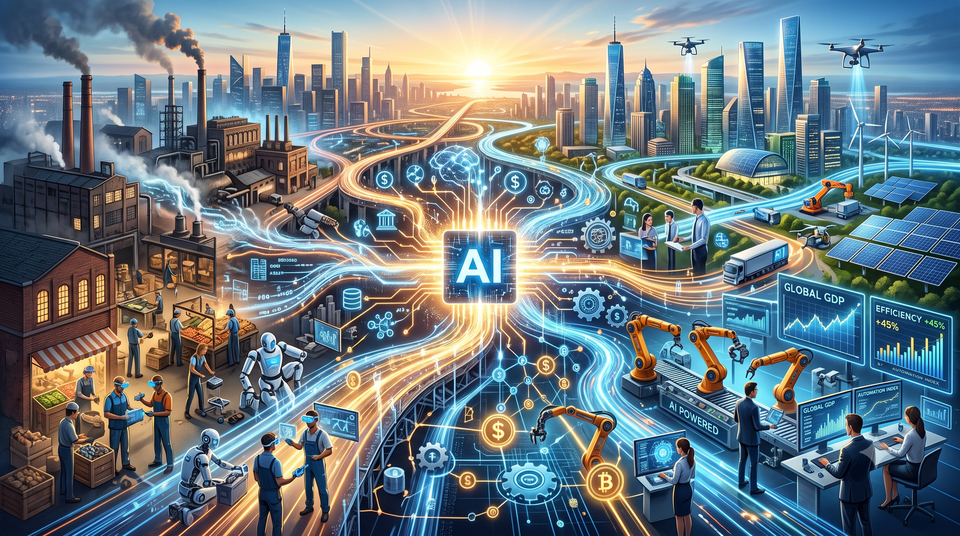
When skeptics, builders, and Nobel laureates sign the same warning, I do not panic. I start looking for the missing metrics dashboard.
On July 13, 2026, more than 200 economists and AI researchers, including 16 Nobel laureates, released “We Must Act Now: A Statement on AI’s Transformation of the Economy,” organized by the Stanford Digital Economy Lab. The line that caught the media was simple and loud: Artificial Intelligence (AI)'s economic transformation could be "larger than the Industrial Revolution, but unfolding over a vastly shorter time frame."
My default reaction to big open letters is caution. In my opinion, it might even warrant a small eye roll.
Technology has a long history of producing manifestos, counter-manifestos, and very confident predictions that age badly. Anyone who has spent enough time around Enterprise systems, cloud migrations, Agile transformations, blockchain pilots, metaverse decks, and now Artificial Intelligence roadmaps develops a healthy respect for reality. Reality is stubborn. It does not care about keynote energy.
Still, this one deserves attention.
That's not because it is perfectly written, and the Industrial Revolution comparison is not clean. But the signatory mix is unusual - you got to admit that! When labor-market skeptics, AI optimists, and executives from Anthropic, Google, and OpenAI all attach their names to the same 88-word warning, I pay attention.
The Coalition of the Unwilling

The most interesting part of the letter is not agreement on the future. It is agreement that we are badly under-instrumented.
The real story behind the "We Must Act Now" statement is not that everyone suddenly became an Artificial Intelligence doomer. They did not.
Take Daron Acemoglu and Simon Johnson, the MIT economists who shared the 2024 Nobel Prize in Economics with James A. Robinson. Their work has pushed back against the lazy version of technology optimism, the kind that says, "Innovation happens, productivity rises, everyone wins."
History is not that tidy.
Institutions matter. Bargaining power matters. Education systems matter. Governance matters. The same technology can raise wages in one setting and hollow out opportunity in another.
That is why I found Acemoglu's reaction very interesting to me. He publicly noted on X that he disliked the viral comparison to the Industrial Revolution. However, he still signed the statement because he "wholeheartedly" agreed with the need for institutional preparation.
That is not a small detail.
When the economist who keeps warning that technology does not automatically serve society sits near the same table as the companies building frontier models, it does not mean they agree on the destination. It means they agree the vehicle is moving in an alarming direction and the metrics dashboard is embarrassingly thin.
And that, in my opinion, is the serious part.
Three Realities, Not One Story
Artificial Intelligence is not hitting the enterprises like a wave. It is hitting like uneven weather across different altitudes.
Is AI already dismantling the workflows at enterprises?
The honest answer is boring, which usually means it is closer to true: not broadly, not yet, and not evenly.
According to a Yale University Budget Lab analysis, 33 months after the release of ChatGPT, the broader labor market had not experienced a clear economy-wide disruption. The shift in occupational mix was only about 1% faster than the historical baseline of the early internet era.
A United States Census Bureau working paper on Artificial Intelligence diffusion found that only 2% of firms reported AI-related employment decreases.
So why does the ground feel noisier than the chart?
Because the average hides the pain. AI is moving through the market at three different speeds. It is affecting differently for high-exposure junior work, mid-level and senior professionals, and large enterprises.
The work is changing for all three.
Quietly. Then suddenly.
The Deleted Slack Phenomenon
Productivity tools often save time for the system before they save time for the worker.
For many knowledge workers, the current Artificial Intelligence reality is intensification.
An National Bureau of Economic Research (NBER) working paper on AI and the Extended Workday found that higher occupational exposure to AI is actually associated with longer work hours and reduced leisure time.
That should make every leader pause.
The naïve version of the AI story says, "This tool makes tasks faster, so people get time back."
In my opinion, this is sometimes the case.
However, organizations rarely leave recovered time sitting on the table. When the marginal cost of writing, coding, summarizing, designing, or analyzing drops, demand often rises. Economists have a name for this kind of rebound effect. In technology teams, we call it "Tuesday."
The productivity tool arrives, and somehow the Sprint Backlog becomes more ambitious.
This is the corporate version of Jevons paradox. If generating metrics dashboards becomes cheap, leaders ask for more metrics dashboards. If writing user stories becomes cheap, teams generate more user stories. If code scaffolding becomes cheap, Product Managers ask why the feature is still two quarters away.
This is what I mean by deleted slack.
Slack is not laziness. Good teams need slack. It is the space where engineers think before they build, review before they ship, mentor juniors, clean up bad abstractions, question weak requirements, and catch the kind of risks that do not appear in a burn-down chart.
Remove too much slack, and you do not get a superhuman team.
You get a brittle one.
The Observability Problem
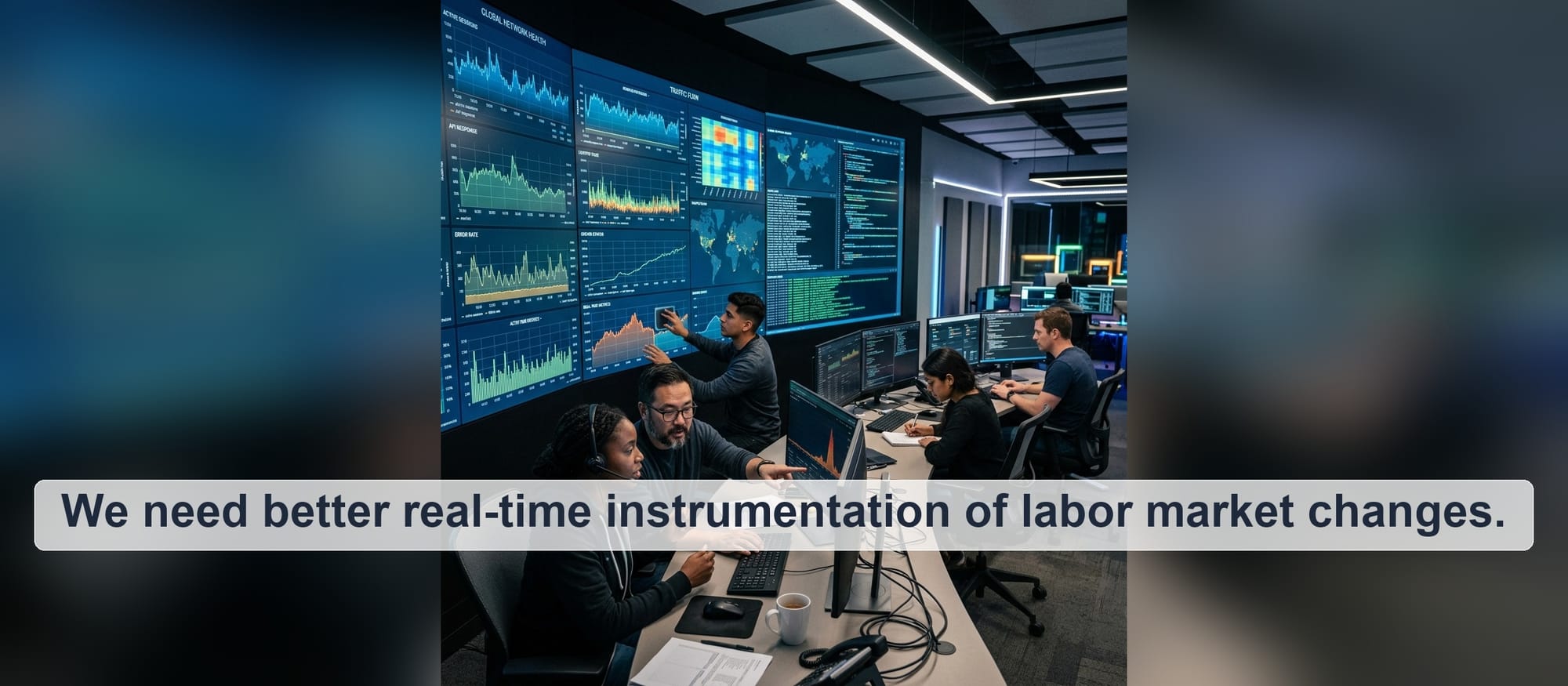
We would never run production systems this blind, yet we are doing it with the labor market.
As engineers and technology leaders, we would not deploy a large, stateful microservice architecture into production with poor logging, weak tracing, and no meaningful telemetry.
Yet that is close to how we are deploying GenAI into the economy.
We are trying to understand a fast, compounding shift with slow, backward-looking instruments. The United States Bureau of Labor Statistics (BLS) still relies on occupational frameworks that struggle to capture AI-augmented task flows.
That matters.
If a developer uses AI to complete 30% more tickets, is that a productivity gain, a workload increase, or both? If a legal team drafts faster but reviews more contracts, where does that appear?
This measurement gap also creates observer bias. The people most loudly debating Artificial Intelligence disruption are often engineers, researchers, writers, analysts, economists, and founders. In other words, people sitting close to the blast radius of knowledge-work automation.
They are useful sensors.
They are also not the whole economy.
Early sensors can be right about direction and wrong about scale. That is why better instrumentation matters more than louder arguments.
What Acting Now Should Mean
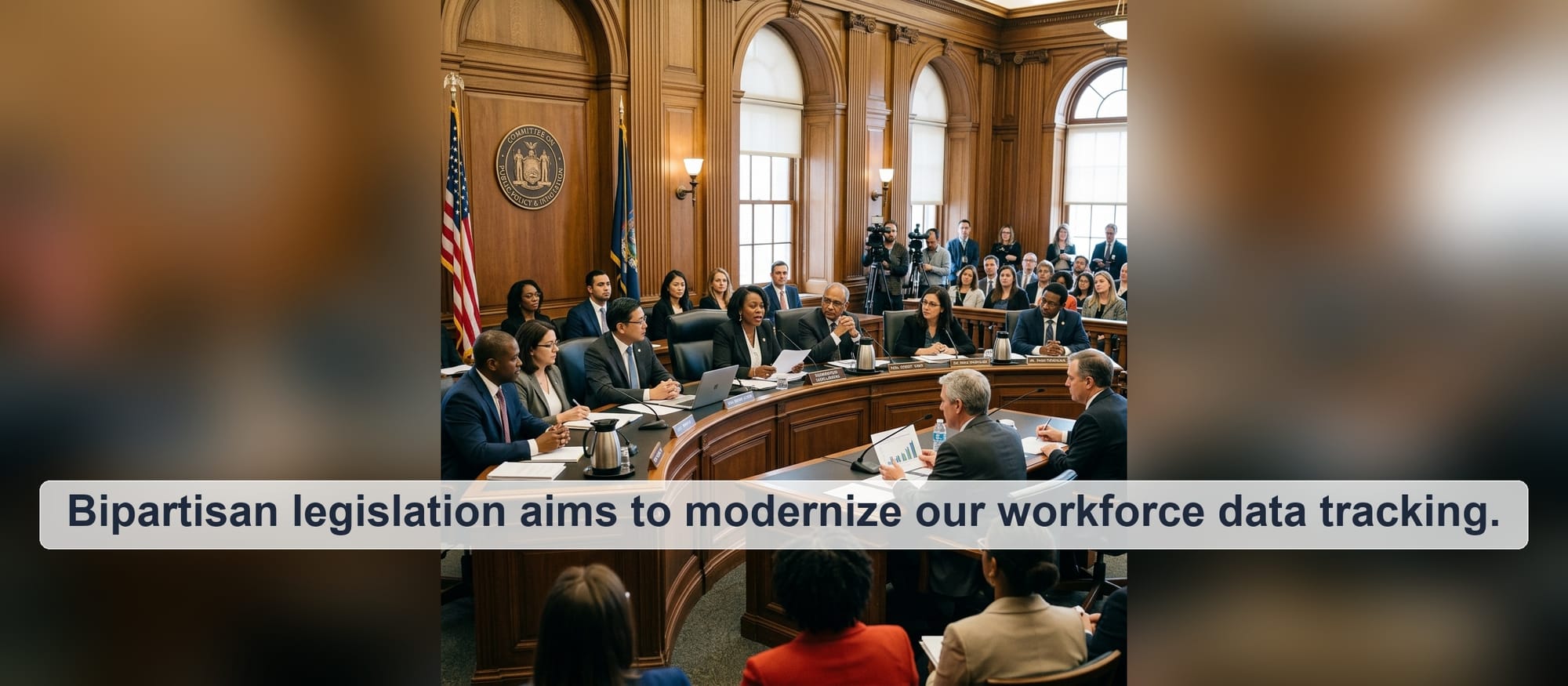
The practical answer is not panic regulation. It is measurement good enough to support adult decisions.
The phrase "act now" can mean almost anything, which is why it often means nothing.
I do not believe we need a grand "Ministry of Artificial Intelligence Destiny." That sounds like something from a bad science fiction procurement process. What we need first is much simpler: an observability layer for AI's labor impact.
Some of the scaffolding already exists.
On June 10, 2026, Senators Mark Kelly, Jim Banks, and Todd Young introduced the bipartisan AI DATA Act. This is one of the more practical institutional responses because it does not start by inventing a giant new bureaucracy. It aims to modernize existing federal statistical systems.
That is sensible.
The proposal points in two useful directions:
- The United States Census Bureau would add questions on Artificial Intelligence (AI) adoption and workforce impacts to the Business Trends and Outlook Survey (BTOS), helping track firm-level adoption patterns closer to real time.
- The United States Bureau of Labor Statistics (BLS) would update legacy surveys to better capture hiring pipelines, work hours, task intensity, and changes in job design.
That is Phase 1: baseline instrumentation.
Phase 2 should go further, but carefully. We need privacy-preserving, aggregated reporting standards from frontier AI platforms. Not Enterprise secrets. Not employee surveillance. Not a compliance circus.
Think of it more like economic telemetry.
We already track energy usage, payment volumes, shipping activity, and financial flows because they tell us how the system is behaving. Artificial Intelligence task automation may become a similar signal. If AI usage surges in customer support, software development and testing, document review, or data analysis, policymakers and business leaders should not wait three years to learn what changed.
The trick is to measure without exposing proprietary IP or creating a surveillance machine. Hard? Yes.
Still easier than steering blind.
What Tech Leaders Should Do Now
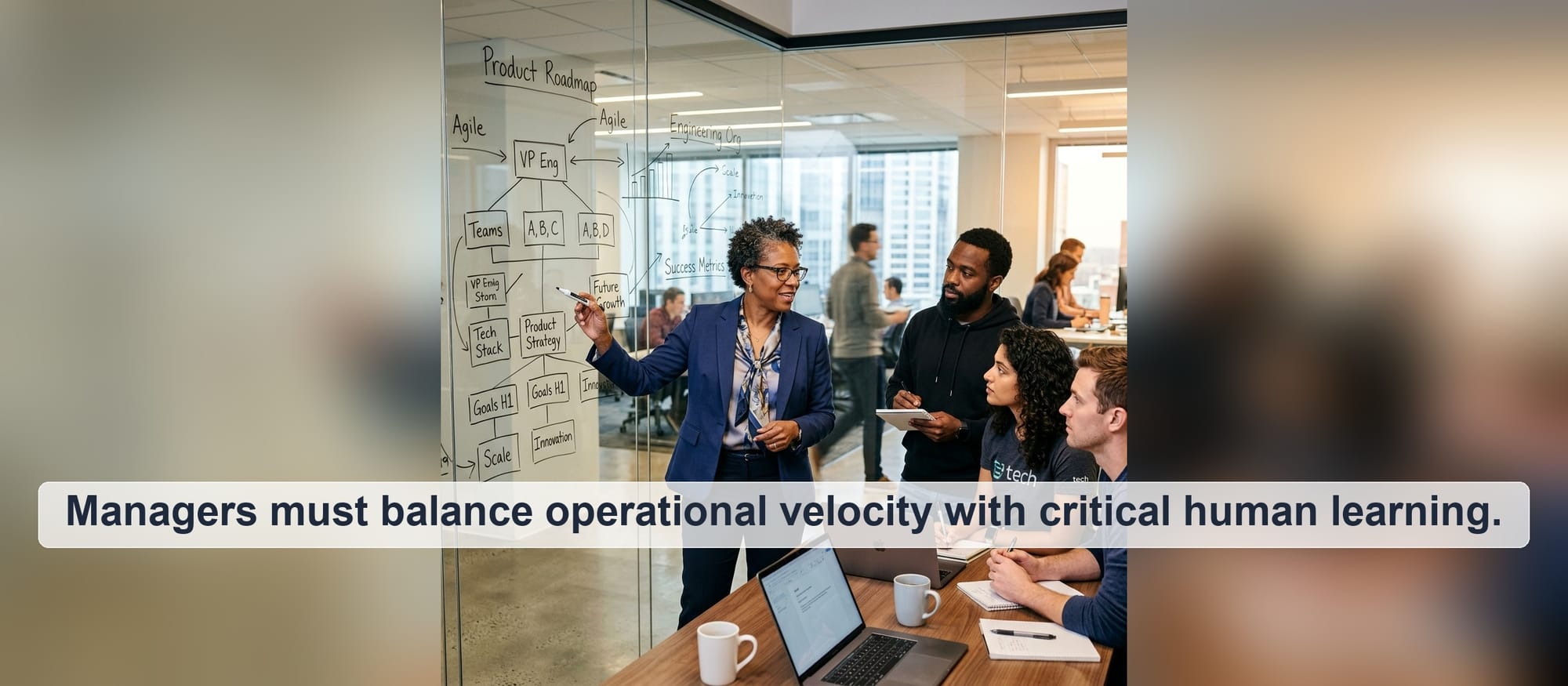
Do not wait for perfect data before you manage the risks sitting inside your own organization chart.
While policymakers argue over measurement, technology leaders have work to do inside their own organizations.
I would start with a few practical questions:
- Where are we using AI to reduce toil, and where are we using it to raise output expectations?
- Which entry-level tasks are disappearing, and what replaces them as training ground for junior talent?
- Are senior people becoming more effective, or just more overloaded?
- Are teams shipping better systems, or simply shipping more artifacts?
- What work should not be accelerated because judgment matters more than speed?
That last question is uncomfortable, which is why it matters.
Not every task benefits from acceleration. Some work needs friction. Security reviews need friction. Architecture decisions need friction. Incident analysis needs friction. Hiring decisions need friction. If we automate the easy parts and compress the thinking time, we may confuse velocity with competence.
I believe the better AI strategy is not "use it everywhere."
The better strategy is to decide where speed creates value, where speed creates risk, and where human learning still needs room to breathe.
Conclusion

Build the metrics dashboard before arguing over who gets the steering wheel.
Economists have famously predicted nine of the last five recessions. Technology leaders have not been much better with transformation timelines, if we are honest.
However, this Artificial Intelligence shift has a different challenge. It may move faster than our normal measurement systems can handle.
The right response to the Nobel laureates' warning is not panic. It is also not smug dismissal. Waiting for unemployment statistics to settle the debate is like waiting for a smoke alarm after the server room is already warm.
We need better telemetry.
We need to watch junior hiring, work hours, task intensity, internal mobility, backfills, vendor consolidation, and AI usage patterns. We need to separate productivity from pressure. We need to protect learning pathways, not just optimize output.
What are you seeing in your teams? Is AI giving people time back, or is it quietly raising the bar for everyone?
Citations and Further Reading
Stanford Digital Economy Lab: "We Must Act Now" Statement and Signatories
Full Statement & Signatory List: WeMustActNow.ai
Senator Mark Kelly: Kelly, Banks lead labor AI data bill
Yale Budget Lab: New data show no AI jobs apocalypse-for now
NBER Working Paper: AI and the Extended Workday: Productivity, Contracting Efficiency, and Distribution of Rents
U.S. Census Bureau Working Paper: The Microstructure of AI Diffusion
Peterson Institute for International Economics (PIIE): Measuring the AI economy
Noah Smith's Critique: Why I Didn't Sign the "We Must Act Now" Statement (Yet)

Comments ()