
The AI Security Paradox: Is Anthropic's Mythos a Smoke Alarm or a Blowtorch?

AI is starting to find security flaws faster than most companies can fix them.
I am working in software engineering for decades. I usually take "breakthroughs" with a healthy dose of skepticism. Usually, these so-called breakthroughs arrive with slick presentations, shiny logos, and a staggering amount of operational cleanup for someone else down the line.
But this time, Anthropic's new Mythos AI model, along with its protective arm, Project Glasswing - really demands a serious look.
This is not magic. We do not expect AI to suddenly erase decades of accumulated technical debt while we all casually sip coffee. The actual significance of Mythos, surprisingly, is much simpler: it marks a massive change in who finds exploitable weaknesses, how fast they work together, and the immense stress that then hits every single patching, incident response, and risk management system still moving at a human pace.
That is the real problem.
Used smartly, a Mythos-level model could genuinely help defenders dig up critical, hidden flaws in old code, open-source stuff, web browsers, even operating systems, and vital infrastructure components that’ve been quietly risky forever. But what if it's used badly? Or, worse, if bad actors get their hands on it? That exact same power can shrink the time from finding a vulnerability to having a fully working exploit. Weeks become mere hours. That is a major problem.
Here's my take. The good side of Mythos is really positive. But so is the danger. Honestly, though, a lot of today's enterprise security programs just aren't built to handle this speed.
Subscribe (button at top right) to get these blogs in your inbox, and enjoy additional features!
The Defender's Case: A Chance to Finally Get Ahead
Defensive AI is valuable only if it helps teams find the bugs that actually matter.
Security teams haven't just lagged; they've been utterly defeated for a good while. You hear these often:
- The code is too old.
- Too many legacy dependencies.
- So many internet-facing services exist, and who really owns them?
Nobody seems to know the answers to these. Not enough folks are around who can spot a truly nasty memory corruption bug, or some weird parser edge case, or even a totally broken authorization path, and then, without hesitation, state, "Yup, that's gonna hit us hard."
That's precisely where Project Glasswing becomes quite fascinating. Anthropic's trying to get Mythos to defenders first. They're offering both access and funds, specifically for open-source maintainers and security organizations. Honestly, I like the idea. But here is the thing: merely finding more problems does not make anyone suddenly safer. Discovery only helps if it drives firm prioritization, quick ownership assignment, and, what's more, fixes that actually leave the gate. Still, this sort of model could genuinely shift the game in three important spots.
Finding Ghosts in the Machine

The scariest bugs are often the old ones everyone stopped questioning.
Anthropic's red team watched Mythos work. This thing found weak spots and flaws that had somehow slipped past 10, 16, even 27 years of human eyeballs and live use. It even sniffed out bugs in every single big operating system and browser.
Any engineering leader really should pay attention. We all got those systems. Don't we? The old service nobody wants to mess with. That library, it's just always been there, right? A parser picked up from some old company. Or perhaps it is that one piece of code which sails through every test, only because the tests themselves just prove what we believe already. Old code just fades into the background, doesn't it? People have literally worked around it for years. Imagine a model that can constantly prod at antique code, find out what could be used against us, and spot glitches humans never even glimpsed? Now that is something.
This could totally change how we handle some aspects of checking old security issues, making it less like digging up history and more like a real, active check. Not perfect. Not completely automated. But it sure beats just hoping some security expert, or worse, an attacker, does not trip over a trap laid two decades ago.
From Alert Floods to Actionable Intelligence
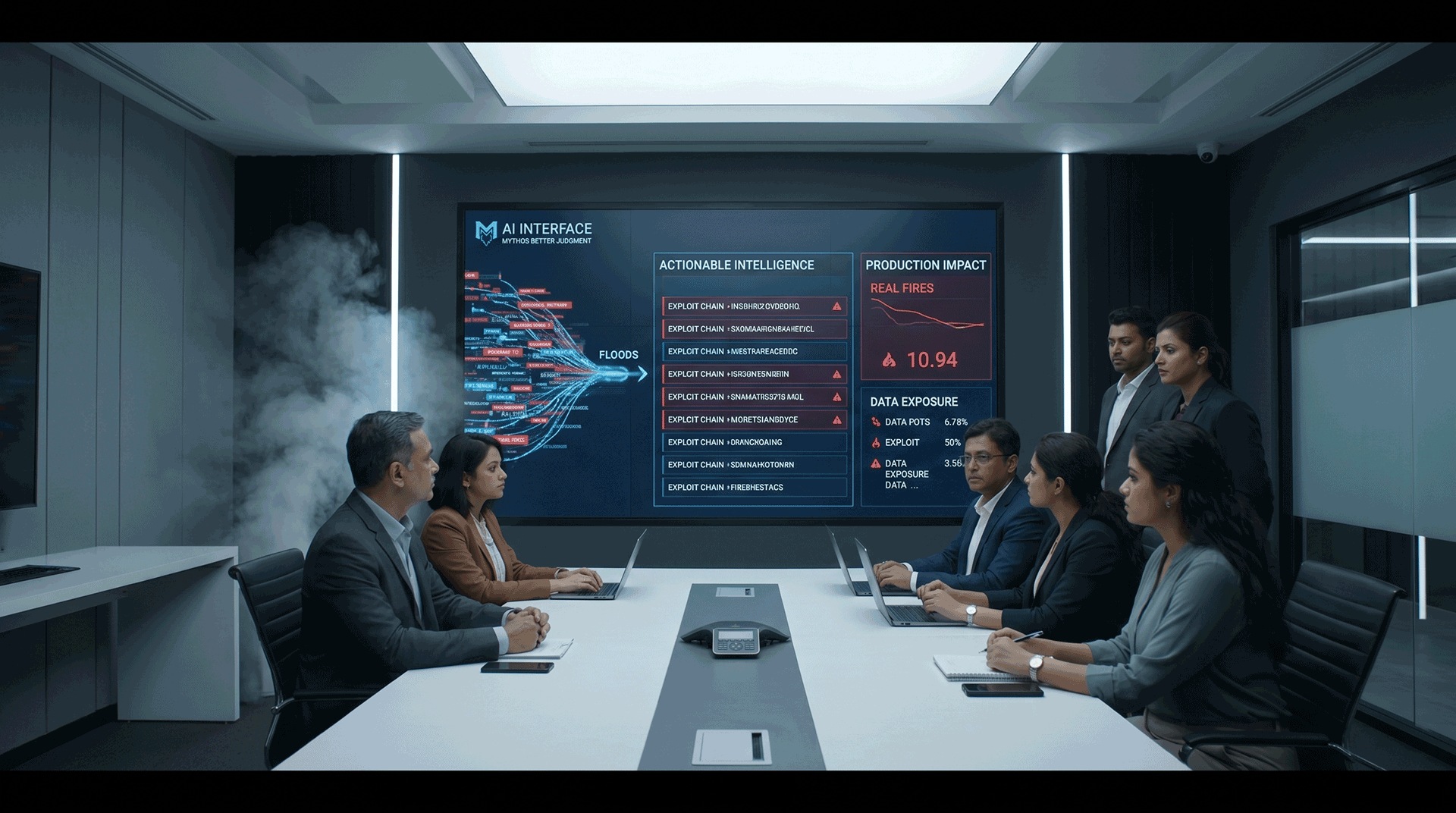
The next security advantage is not more alerts, it is better judgment at scale.
Security teams are absolutely buried, aren't they? The backlogs are impossible to conquer. You've probably been there yourself, stuck in some endless engineering meeting, agonizing over whether a blaring scanner alarm signals a genuinely exploitable flaw, whether it is even reachable from the outside world, or if it is just another digital phantom, a ghost in the machine.
That is when the true, devastating expense hits you squarely in the face. Hours are simply wasted. Trust disappears. That's where Mythos thinking shines. Anthropic's red team research showed Mythos aligned remarkably well with how human experts rate real risks. That's a big deal. The truly important question isn't usually, "Is this just another bug we found?" Nope. Far more pointed inquiries prove helpful: can someone actually exploit this in the wild, in a production setting, where it really matters?
- Can it be exploited without special access?
- What privilege does it give an attacker?
- Does it expose data?
- Is it part of a chain?
- Should this interrupt planned engineering work?
A tool that helps answer those questions can save real effort. It can also help security teams spend their credibility wisely. Engineers will move fast for a real fire. They get tired of smoke machines.
A Security Sidekick for Open Source
Open-source maintainers protect the world's software supply chain with far fewer resources than the job deserves.
Open source runs everything. It isn't just a pretty phrase; this truth lives in the very code modern software engineers touch every single day. But here's the catch: so many unbelievably vital open-source endeavors frequently rely on tiny crews, folks who volunteer their time, or individuals who cram critical security duties into long hours, often after their actual work day has concluded.
Picture this: a vast global digital network, all built upon foundations of code, projects often barely held stable by sheer smarts, genuine kindness, and, frankly, some incredibly exhausted person clutching a pager. That's not a jab. It's a genuine problem with the entire system we've thrown together around these dedicated individuals.
Project Glasswing, which offers aid to groups like the Apache Software Foundation and the OpenSSF, looks like a genuinely important step. Improved tools, more computing muscle, and artificial intelligence assisting with tricky analysis will unquestionably empower maintainers to uncover issues much quicker.
But we have to be honest. Finding ten thousand problems? Sure, that's progress. Actually fixing, reviewing, testing, meticulously getting the word out, and then releasing those ten thousand patches? That's an entirely different ballgame. That bit still demands real people, robust processes, adequate funding, and, quite simply, good judgment. AI gives us a brighter flashlight. Someone still has to actually go into the basement.
The Attacker's Advantage: When Exploits Move at Machine Speed

The same tool that helps defenders find weak spots can help attackers turn them into a working path.
Here's the real kicker: defense becomes offense. Even Anthropic's own red-team report actually confirms this. Mythos can pinpoint zero-days. It links them up. Then, if instructed, it exploits them all, alone. Don't just breeze past that last part. It isn't merely that an AI spots a bug. Machines have been finding errors automatically for decades.
But here is a genuine concern: an agent, something that reasons through every bit of a system and finds weak spots, starts writing exploit code, tests, adjusts, and keeps going until it meets its goals in a loop 24x7.
This utterly shifts how corporate security teams perceive their timeline. Many legacy programs still rely on simple friction. Cybercriminals need time. Crafting an exploit demands serious know-how. Often, patches won't even arrive until the next development sprint. And, mitigation steps might just sit, waiting for a suitable change window. What happens if all that built-in friction just disappears? Those comfortable, old-school security routines suddenly become outrageously expensive.
The Incredible Shrinking Maintenance Window
Monthly patching was built for a slower threat model.
Lots of businesses only patch once a month. A few handle it okay. But many more just keep that pace since their entire system, how they do business, test things, get changes signed off, who's in charge of what sort of grew into it.
But if some bad guy can flip a regular patch or a fresh vulnerability warning into an actual attack in just a few hours? We’ve got a real problem then.
Telling yourself, "We'll tackle that next sprint," begins sounding less like a real plan and more like you're just hoping. AI's lending a hand to attackers. So a CVE isn't just another thing on your to-do list anymore. No, it is a countdown.
You are already seeing this crazy pressure show up in discussions about fresh policies. For instance, CSO Online even mentioned CISA might shorten some critical fix-it periods from two weeks down to a mere three days. Can every place actually hit those kinds of deadlines right now? That almost does not matter. The bar's shifting. Because those new expectations, trust me on this, won't just stay expectations. They become audit nightmares, customer insists, pointed questions from the big shots, even tweaks in contract fine print.
The Power of the Chain
Most real breaches do not need one perfect bug, they need a path.
Most security programs look at threats one at a time. This CVE? High. That finding? Medium. This specific gap? Acceptable until next quarter.
But attackers do not operate like that. They hunt for paths. An information leak. A badly configured service account. A sandbox escape. Maybe a forgotten admin endpoint. Or a privilege escalation that only matters after the first two steps are complete. One loose tile will not bring the ceiling down, typically. All those tiles combined? That's a problem.
My simple take on the Mythos research is this: AI agents are going to get profoundly better at this type of comprehensive system reasoning. They will not just ask, "how bad is this bug?" Instead, they'll inquire: "What does this bug enable?" Anthropic confirmed Mythos actually chained multiple Linux kernel bugs to gain root (See this). It also managed to build browser exploit chains. This absolutely ought to challenge how your risk registers function. If your scoring model can't spot these interconnected chains, you might just be drastically underestimating the true danger.
The Asymmetry of Speed
Attackers can parallelize discovery while defenders still route tickets by hand.
Here is the mismatch that worries me most. Autonomous agents can turn vulnerability research into a parallel search problem. They can try many hypotheses, inspect many code paths, build candidate chains, and learn from failed attempts quickly.
Enterprise remediation is often the opposite. Find the owner. Open a ticket. Confirm the asset. Ask whether it is production. Check business impact. Wait for a change window. Run regression tests. Handle the exception. Get approval. Reopen the ticket because the fix broke something.
I am not mocking that process. Some of it exists for good reason. Stability matters. Customers matter. Uptime matters. But the attacker does not wait for CAB approval. That operational gap is where the systemic risk lives. It is not only about better offensive AI. It is about slow defensive plumbing.
The Real Prize: Widespread Data Exposure

Attackers do not want bugs for their own sake, they want the data behind them.
Forget software flaws. This is about access. Assisted by AI, an attacker isn't stopping at shell access. That only looks neat in a demo. The actual bounty? Customer data. Login details. Source code. All those financial papers. Intellectual property. Don't forget the tiny tokens and admin panels. And trusted system connections. Companies today provide countless entryways for bad actors to morph a minor foothold into a catastrophic data leak.
Browsers, for example. They're essentially the main entrance to email, your finances, CRM, cloud control panels, dev tools, and every internal application you use. This LinkedIn Post, detailing Mythos's capability to discover cross-origin data access vulnerabilities, is not just a small browser security footnote. It means something much worse. Getting into a browser gives direct access straight into active, logged-in sessions.
And then cloud environments fundamentally alter everything. Securing root access on a server isn't the grand prize it once was. But grabbing a workflow's identity? Far more valuable. If a service role possesses broad permissions, a singular exploit lays an easy route to cloud storage, databases, hidden secrets, and much more. The bad guys already know this. Mandiant's M-Trends 2026 report points out that attackers are increasingly targeting user credentials, OAuth tokens, and SaaS spaces. Why do they do it? To pivot. To widen their access. AI won't invent these tactics. It will simply accelerate them dramatically.
The Bottleneck Has Moved: It Is No Longer Discovery, It Is Response
The organizations that win will be the ones that can act faster than the exploit chain spreads.
For ages, locating all the software security flaws was difficult, especially legacy systems. If the promise of Mythos is true, that’s not going to be the fight anymore. It will be how we respond. The real struggle lies in getting a fix out the door: sorting through the whole convoluted mess, figuring out who's accountable, prioritizing what absolutely needs attention, slapping on patches, trying to keep the problem from spreading, then cleaning up the books, and ultimately reducing the harm. All of it. IBM's latest report, the 2025 Cost of a Data Breach Report, actually showed that finding and shutting down a breach still averaged 241 days. Nearly eight months!
I do not consider Anthropic the culprit here. Their slow, deliberate release and open disclosure approach? Precisely what conscientious firms must do. I support them.
The real concern lies elsewhere. Mythos has unveiled a potent new technique, one which will not be contained to a single laboratory indefinitely. Once a fresh approach proves its worth, everyone in the business needs to understand it will circulate. Not right away, perhaps. Or even neatly. But it is going to spread. Those in charge of security had better get ready for this new reality right now. They should not sit idly by until some horrific event causes the higher-ups to demand answers about why this was not anticipated.
What Should We Do Now?
We need to rebuild security operations around speed, ownership, and limited blast radius.
This isn't a situation where you can just buy a single tool and then sit back and relax. I wish it were that simple. The reality is that we need to adopt a completely different approach to how we operate. While having the right tools is important, the real challenge lies in overhauling our processes, architecture, incentives, and even our muscle memory. With AI reducing the time we have to respond to threats, our defense strategy needs to be more streamlined, with fewer handoffs, clear ownership, and established emergency protocols that can be quickly activated. That's where I think our focus should be.
Inventory Your Blast Radius
You cannot defend the systems you cannot find, and attackers love forgotten doors.
Let's start with the basics: don't overlook the importance of knowing what you have in your systems. Begin by prioritizing the systems that face the internet and those that are closely related to identity, such as VPNs, SSO, CI/CD pipelines, cloud control planes, developer platforms, secrets stores, admin portals, and SaaS integrations - these are essentially the new entry points to your systems. Creating an inventory of your assets may seem like a dull task, but it's very important, much like brakes on a car.
Rethink Your Patching Cadence
Calendar-based patching is not enough when exploitability changes by the hour.
Monthly patching will not disappear. Many systems need careful testing and controlled release windows. But high-risk vulnerabilities need a different lane. Treat exploitable N-days and KEVs, or Known Exploited Vulnerabilities, with emergency-level urgency. Build a risk-triggered model where evidence of active exploitation, public exploit code, internet exposure, or easy chaining changes the SLA immediately. This also requires business alignment. Engineering teams cannot hit emergency timelines if every exception needs a meeting with twelve people and a spreadsheet. Pre-approve the path. Define the authority. Practice it before you need it.
Limit Blast Radius Aggressively
Assume one control will fail, then make sure the failure cannot travel far.
- Enforce least privilege for service accounts.
- Use short-lived and tightly scoped tokens.
- Segment networks and workloads.
- Monitor identity behavior, not just endpoint behavior.
- Remove standing admin access wherever possible.
- Review cloud roles for real use, not imagined need.
- Make secrets rotation boring and repeatable.
The best breach is the one that never happens. The second-best breach is the one that gets stuck in a small room with no useful doors.
Start Using AI Defensively
Waiting for perfect AI security tools is just another way to fall behind.
You don't need to have access to the latest technology to start building good habits when it comes to defensive AI. Instead, you can use the current models that are available to help with things like reviewing code, identifying potential threats, generating tests, summarizing incidents, and cleaning up documentation.
It's also important to keep humans involved in the process and to protect sensitive information. You should always check the output of these models to make sure they are accurate and not producing false information. And definitely don't give a chatbot too much power, like admin rights, without proper supervision.
But the key is to get started.
Prepare for Volume
The vulnerability backlog is no longer a queue, it is a treadmill that just got faster.
As AI-powered discovery tools become more widespread, the number of reports generated will skyrocket. While some of these reports will be highly accurate and relevant, others will be duplicates, technically correct but operationally useless, or even downright misleading - essentially, noise disguised as insight.
To effectively manage this influx of information, your intake process must be equipped to handle the variability in report quality. Automation will be key: implementing automated deduplication, validation, ownership mapping, reachability checks, and evidence collection will help streamline the process.
Final Thoughts
The future is not AI offense against human defense, it is AI-assisted offense against disciplined, AI-assisted defense.
So what do I feel about Anthropic's Mythos? I think of it as a smoke detector. And, well, a blowtorch, too. It uncovers concealed dangers. It does not just spot them either; it lays bare the shocking speed with which someone might weaponize those nascent infernos.
Project Glasswing serves a valuable purpose, yes, but that's hardly the full picture. The actual remedy resides in our actions.
What honestly matters here? Can we fix critical flaws without delay? Is shrinking the potential blast radius possible before an incident even occurs? Will identity protection receive the same intense scrutiny we once reserved for network perimeters? And can we deploy AI without letting it take total control? That's the real hurdle.
The competition has begun…
Citations and Further Reading
- Project Glasswing: Securing critical software for the AI era - Anthropic
- Assessing Claude Mythos Preview's cybersecurity capabilities - Anthropic Frontier Red Team
- 2025 Cost of a Data Breach Report: Navigating the AI rush without sidelining security - IBM
- Verizon DBIR 2025 Key Stats for Network Defenders - Eclypsium
- CISA mulls new three-day remediation deadline for critical flaws - CSO Online
- M-Trends 2026 Report - Mandiant / Google Cloud
- Mythos autonomously exploited vulnerabilities that survived 27 years of human review - VentureBeat
- How AI is getting better at finding security holes - NPR
- Introducing Project Glasswing: Giving Maintainers Advanced AI to Secure the World's Code - Linux Foundation
- The Apache Software Foundation Announces $1.5M Donation from Anthropic - The ASF Blog
- Claude Mythos: The Exploits That Forced Anthropic's Hand
- Claude Mythos and the AI Autonomous Offensive Threshold - Cloud Security Alliance

Comments ()