
Beyond the Pipeline: Why Developer Experience (DevEx) is Your True Velocity Metric.
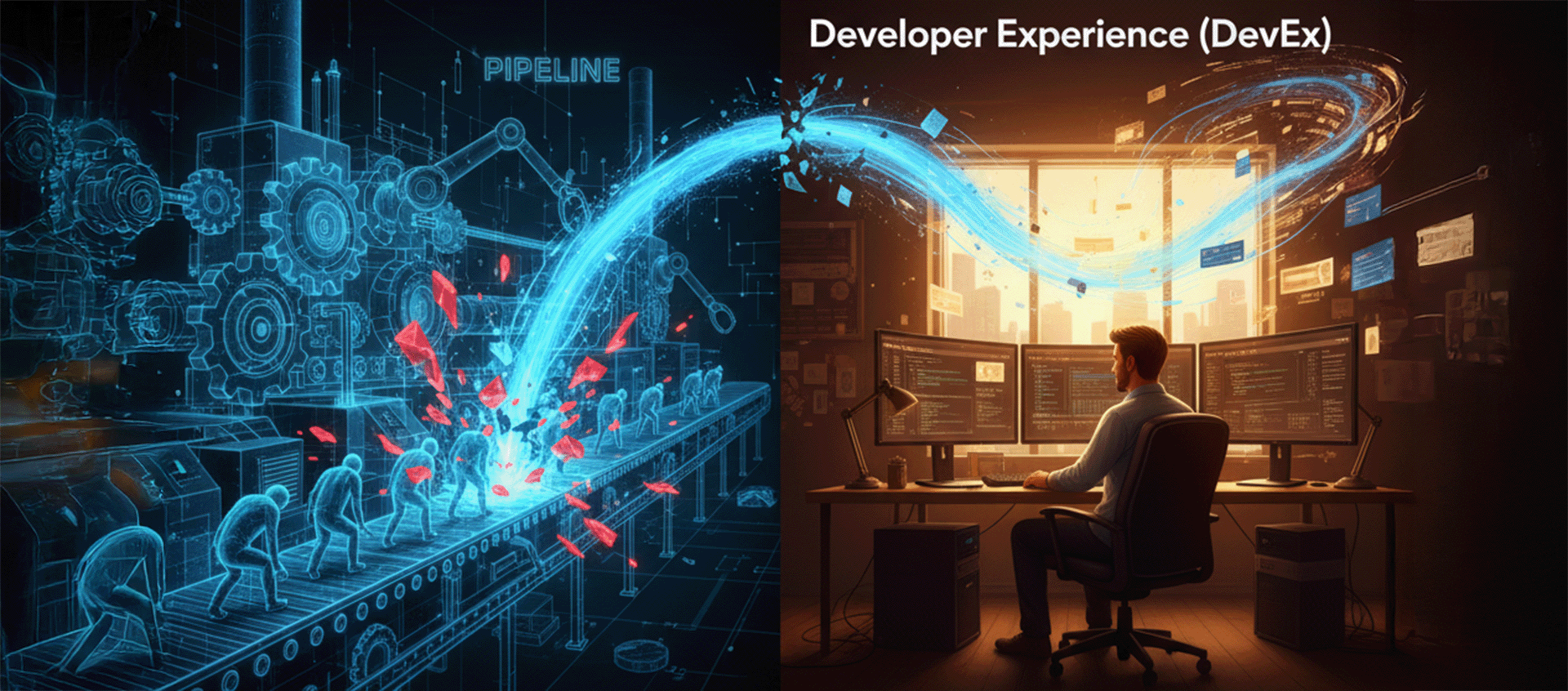
Your most expensive asset is sitting idle. I'm not talking about your cloud spend; I'm talking about your brilliant, highly-paid engineers. We've all seen it: they're just... waiting. Staring at a lagging build, fighting a flaky test suite, or stuck on a pull request that’s been sitting for a day. Their momentum is gone, shattered by friction that has nothing to do with their ability to solve hard problems.
We’ve spent years optimizing pipelines and chasing the perfect deployment frequency. But that nagging feeling that we weren't reaching our true potential never went away. It turns out we were tuning the engine while ignoring the driver.
The missing piece is Developer Experience (DevEx). It's not about beanbags or free snacks; it’s the sum of every interaction an engineer has with the systems and processes we build around them. It's about eliminating the frustrating waits that kill focus and creativity. This isn't a nice-to-have, it's a core strategic driver for any company that wants to win with technology.
Quick-read, Visual Version
Questions? Want to chat with my blogs?
Visit "Questions" tab.
The Measurement Dilemma: Moving Beyond DORA

DORA metrics tell you the “what” of your delivery pipeline, but they don't tell you the “why” or the “how much it hurt”.
For the better part of a decade, the DORA metrics: Deployment Frequency, Lead Time for Changes, MTTR, and Change Failure Rate, have been the gold standard. And for good reason. They give us a clear, objective look at the health of our delivery machine. If you aren’t tracking them, you’re flying blind.
But here’s the problem we’ve seen time and again: you can have world-class DORA metrics and still have a team that’s burning out. DORA tells us what happened, but it doesn't tell us about the developer's journey. Did that fast deployment require heroic effort, navigating a maze of confusing tools and poor documentation? Relying only on DORA is like judging a car's performance solely by its lap time, without asking the driver about the steering, the brakes, or the visibility. As OpsLevel points out in "Why DORA Metrics Aren't Enough for Engineering Teams", this narrow view misses the human factors that are the real predictors of long‑term success.
To get the full picture, we have to measure the developer's reality, which I’ve found boils down to three pillars:
- Cognitive Load: How much mental energy does it take just to get started on a task? Convoluted access processes, complicated codebases, poor docs, and a disjointed toolchain are the main culprits here.
- Feedback Loops: How fast can an engineer find out if they’re on the right track? This is everything from CI speed to code review turnaround. Slow feedback is a focus killer.
- Flow State: How often can our developers get into that state of deep, uninterrupted work where the magic happens? Constant context switching and system delays are the enemies of flow.
A Layered Framework for Holistic DevEx Measurement

You can't fix what you don't measure, and measuring only the system's output is missing half the equation.
Measuring these pillars requires moving beyond a single set of metrics. A three-layer model is the most practical way to connect the dots between system performance and business results.
Layer 1: Foundational Metrics (The Engine)
This is your baseline, the non‑negotiables. It’s where DORA lives.
- DORA Metrics: Still the best health check for your delivery pipeline.
- Build & Test Latency: Is your CI feedback loop a 30‑second check or a 15‑minute coffee break? Every minute saved is a minute of focus regained.
Layer 2: Experience Metrics (The Cockpit)
This layer measures the developer's day‑to‑day reality. The SPACE framework is an excellent tool here, reminding us that productivity is about more than just activity. It covers Satisfaction, Performance, Communication, and Flow. This is where you start using surveys and qualitative feedback to understand the experience behind the code. Learn more about this multi‑dimensional approach here: What is SPACE? | Developer Experience Knowledge Base.
Layer 3: Outcome Metrics (The Destination)
This is how you answer the “so what?” question from your CFO. It connects all your engineering efforts directly to business value.
- Talent Retention: Are your best engineers staying or leaving? High turnover is a massive red flag for poor DevEx.
- Feature Velocity: How quickly can we take an idea from concept to customer value?
- Innovation Rate: Are teams spending their time on new features or bogged down in maintenance and operational toil?
The Silent Killer: Instrumenting Cognitive Load

Cognitive load is the invisible tax on every single engineering task, and it's compounding daily.
Of the three pillars, cognitive load is the trickiest to measure but often the most damaging. It’s the friction that slowly grinds a team’s productivity to a halt. It’s the death by a thousand papercuts from navigating complex approval processes, or facing significant friction around decision-making, and from unclear code, missing documentation, or having to switch between a dozen different tools constantly. As Worklytics notes, managing cognitive load is foundational to a productive team: Developer Experience: A Developer‑Centric Approach to Productivity.
Here are a few practical, battle‑tested metrics that can be used to get a handle on it:
- Tool Switch Frequency: How often does a developer have to leave their IDE to get something done? If they’re constantly jumping to wikis, design files, and other portals, their workflow is broken.
- Error‑Log‑to‑Documentation Ratio: When an on‑call engineer sees an error, is there a direct link to a runbook, or are they left to guess? A low ratio means you're burning out your engineers during incidents.
- "Time‑to‑Hello‑World": How long does it take a new engineer to get a service running locally? If it takes more than an hour, your platform is too complex or poorly documented (or both). This is one of my favorite proxy metrics for developer friction.
Developer Portal to the rescue
A low-friction "paved road" to production for developers.
A developer portal is the unified interface through which a Platform Engineering team delivers its product: a low-friction "paved road" to production for developers. The core mission is to accelerate the delivery of value by product-aligned teams by providing a stable, secure, and efficient path for the entire software development lifecycle.
The portal is the tangible result of treating the internal developer platform as a product, with the organization's own developers as the customers. This approach shifts from a traditional, ticket-based IT model to a modern, product-centric one focused on user needs and feedback.
A developer portal centralizes and simplifies common developer tasks by providing self-service capabilities. This allows developers to focus on their primary task of building features rather than managing infrastructure.
Key features include:
- Service Scaffolding: Creating new services from standardized, pre-configured templates.
- Infrastructure Provisioning: Allowing developers to provision the infrastructure they need without manual intervention.
- Deployment Management: Providing a unified interface for managing deployments and automated workflows.
- Service and Documentation Discovery: A centralized place to discover all of the company's microservices and access their related documentation, which helps reduce the time developers spend searching for information
See Cortex for an example.
The New Kid on the Block: Taming AI‑Generated Code Debt
AI gives you code for free, but you pay for it with interest in the form of long‑term maintenance.
I’ve seen enough technology waves to know there’s no free lunch. AI coding assistants like Copilot are incredible accelerators, but they’re also creating a new form of technical debt at an alarming rate. We’re seeing a flood of duplicated, often subtly incorrect, and poorly understood code.
As LeadDev highlights, this isn't a hypothetical problem. It's happening now: How AI generated code compounds technical debt. The speed gain today comes with a very real maintenance and security cost tomorrow. My take? Embrace AI, but with your eyes wide open. We need to be instrumenting for this “AI code debt” now, with stricter code reviews and quality gates, before it becomes an unmanageable drag on our systems.
The Microsoft Playbook: Proven Levers for High‑Impact DevEx
The data is in: A great developer experience isn't a cost center, it's a massive lever for innovation and retention.
If you’re still skeptical, don't just take my word for it. Look at the research from Microsoft and GitHub, who have studied this at a massive scale. Their report on Quantifying the impact of developer experience provides hard data that should get any leader's attention:
- Deep Work Time: Developers with protected time for focused work felt 50% more productive.
- Integrated Tooling: Easy‑to‑use, intuitive tools correlated with a 50% boost in innovation.
- Fast Code Reviews: Quick review cycles made developers feel 20% more innovative and satisfied.
- Quick Answers: Fast responses to developer questions correlated with 50% less perceived tech debt.
These aren't soft benefits. This is a clear playbook for driving velocity, innovation, and retention.
Making the Business Case and Scaling Success
Stop talking about “developer happiness” with your CFO and start talking about the cost of turnover and the speed of delivery.
Armed with this kind of data, you can change the conversation. Instead of asking for budget for “soft” improvements, you can build a solid business case. The cost of replacing a single developer is estimated to be anywhere from 75% to 200% of their annual salary (see "Replacing a Developer: The Hidden Costs"). If you can show that improving DevEx will reduce turnover by even a few points, the investment pays for itself almost immediately.
The best way I’ve seen to scale these improvements is with a dedicated Platform Engineering team. Their mission is simple: treat DevEx as a product. They should be obsessed with removing friction and enabling developers to move faster. Their success isn't measured by features shipped, but by the productivity they unlock in every other engineering team.
Conclusion: Stop Chasing Productivity, Start Unleashing It
The best developer experience is invisible. It gets out of the way and lets brilliant people do brilliant work.
For years, we’ve focused on the machinery, trying to squeeze more output from our teams by optimizing the assembly line. The game has changed. The evidence is clear that the biggest gains in engineering performance now come from optimizing the human experience.
By shifting our focus from pure output to a holistic view of Developer Experience, we stop trying to extract productivity and instead create an environment that unleashes it. This is how we unlock the full creative potential of our teams and build organizations that can out‑innovate the competition.
So I’ll ask you: are you spending your time tuning the engine, or are you focused on the person in the driver's seat?
Citations and Further Reading
- "Why DORA Metrics Aren't Enough for Engineering Teams"
- "What is SPACE? | Developer Experience Knowledge Base"
- "Quantifying the impact of developer experience"
- "How AI generated code compounds technical debt - LeadDev"
- "Replacing a Developer: The Hidden Costs"
- "Developer Experience: A Developer‑Centric Approach to Productivity"
For additional frameworks, metrics, and strategies, refer to:

Comments ()