
Your Org Chart Is Your Code's Destiny. Or Is It?
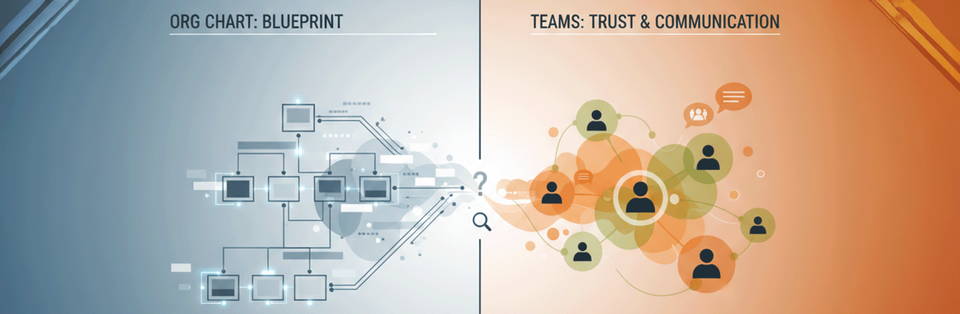
I’ve always gotten a kick out of the saying, “If your Slack channels look like a tangled spaghetti bowl, expect your codebase to taste the same.” It’s a clever way of describing what Melvin Conway told us back in 1967: organizations are destined to produce software that mirrors their own communication structures (Conway's law - Wikipedia). In other words, your org chart is a blueprint for your architecture.
For decades, this was just a sharp observation. But recently, I've seen this idea turned into a strategic weapon. With the rise of microservices and remote work, leaders are intentionally trying to game Conway's Law. This “Inverse Conway Maneuver” (Inverse-Conway-Maneuver: How to speed up product development teams successfully | Thoughtworks United States) is all about redesigning your teams to get the architecture you want.
It's a hot topic, and for good reason. I’ve been on both sides of this fence. I've seen this approach work wonders, and I've seen it crash and burn. So let's cut through the hype and talk about what actually works.
Quick-read: Visit the Visual Blog
The Alluring Promise: Engineering the Perfect Team

Designing your teams to match your desired architecture is tempting, because when it works, the speed is undeniable.
The logic is tempting, isn't it? If team structure dictates architecture, why not build the perfect team to get the perfect architecture? This is the core idea behind frameworks like Team Topologies, which I've seen many organizations adopt to structure their teams around specific functions: stream-aligned, platform, enabling, etc. to support a clean microservices architecture (Team Topologies - Organizing for fast flow of value).
When it works, it’s beautiful. Teams have clear ownership, well-defined boundaries, and you spend less time in meetings arguing about who's responsible for what. The DORA metrics often back this up (The Ultimate Guide to DORA Software Metrics (2025)). In my experience, Mean Time To Recovery (MTTR) is one of the first metrics to improve. When something breaks at 2 AM, there's no confusion about who gets the page. That clarity is worth its weight in gold.
The Counter-Argument: Building Walls, Not Bridges

Be careful what you wish for; a perfectly aligned org chart can easily become a collection of well‑defined silos.
But let’s be honest, the Inverse Conway Maneuver is no silver bullet. I’ve heard the critiques, and I’ve voiced some of them myself. When you get too obsessed with drawing clean lines between teams, you often end up building walls. Communication grinds to a halt, and suddenly you have a new collection of well‑defined silos.
As Patricia Aas rightly points out, organizational structure isn't the only thing that shapes software (Blog | Patricia Aas - Programmer). A small, determined team can build a monolith, and a sprawling organization can sometimes produce elegant microservices. People matter more than boxes and lines.
This is where you fall into the trap of Goodhart’s Law: “When a measure becomes a target, it ceases to be a good measure” (Goodhart’s Law • Agile Coffee). I've seen it happen. Teams become so focused on protecting their boundaries and “owning their metrics” that they lose sight of the actual goal: building a great product for the customer.
There are many examples of the fallout from a “big bang” re‑org. A company splits its engineering org into dozens of small, autonomous squads overnight. The intention is noble: more ownership, faster delivery. The reality? Slower releases, more bugs, and a culture of fear because no one knows who to talk to anymore.
The Pragmatic Path: Psychological Safety Beats a Perfect Org Chart

Stop obsessing over the perfect org chart; the highest‑performing teams are built on trust, not structure.
So where does that leave us? After years of experimenting with org charts, the answer for me has become surprisingly simple. It’s not about the org chart. It's about psychological safety.
The best teams I've ever led were the ones where people felt safe to ask questions, admit mistakes, and challenge the status quo without fear of blame (The (Not So) Hidden Social Drivers behind the Highest Performing Engineering Teams - InfoQ). This isn't just a feel‑good idea; the DORA reports consistently show that trust and psychological safety are the bedrock of elite‑performing teams.
My focus now is less on drawing perfect boxes and lines and more on fostering an environment where smart people can collaborate effectively. This is the heart of socio‑technical systems theory: you have to optimize the human (socio) and technical systems together. Tinkering with one while ignoring the other is a recipe for failure.
A Leader’s Checklist for Navigating Conway’s Law

Use team structure as a surgical tool to solve specific problems, not as a blunt instrument for every challenge.
Drawing clean lines around teams can be a powerful tool, but you have to use it like a surgeon, not a butcher. Before you reach for the re‑org button, here are the questions you should answer:
- How stable is your product architecture? If it's well‑defined and mature, mapping teams to specific bounded contexts can work well. If it's still evolving, I prefer flexible, cross‑functional teams that allow the architecture to emerge naturally.
- What about critical cross‑cutting concerns like security or compliance? Creating a permanent “security team” can become a bottleneck. Some find more success with flexible guilds or establishing clear “shared ownership” contracts that empower every team. But that has its own downsides as well.
- How high is psychological safety in your organization? If trust is high, you can introduce more structure without breaking things. If trust is low, any re‑org is likely to fail. My advice? Pause and invest in building trust first.
- Are you chasing metrics or outcomes? DORA metrics are a fantastic diagnostic tool, but they are not the goal (The Ultimate Guide to DORA Software Metrics (2025)). If your teams are gaming their KPIs, you need to reframe the conversation around genuine business impact.
Conclusion: Use the Mirror, Don’t Be Ruled by It
Conway’s Law is best seen as a mirror. It reflects the state of your organization. If you look at your technical architecture and see a mess, your first thought shouldn't be to redraw the org chart. It should be to ask: “What does this tell me about how we communicate?”
As leaders, we are gardeners of complex systems, not just architects of boxes and lines. Frameworks like Team Topologies are valuable tools in the toolbox, but they are no substitute for the hard work of building trust and fostering open communication.
So before you plan your next re‑org, take a hard look in that mirror. The answer you're looking for probably isn't in a new org chart, but in fostering better conversations.
What's your take? ... Share your story in the comments! 👇


Comments ()