
Is Your Data Lake a GenAI Powerhouse or a Swamp?
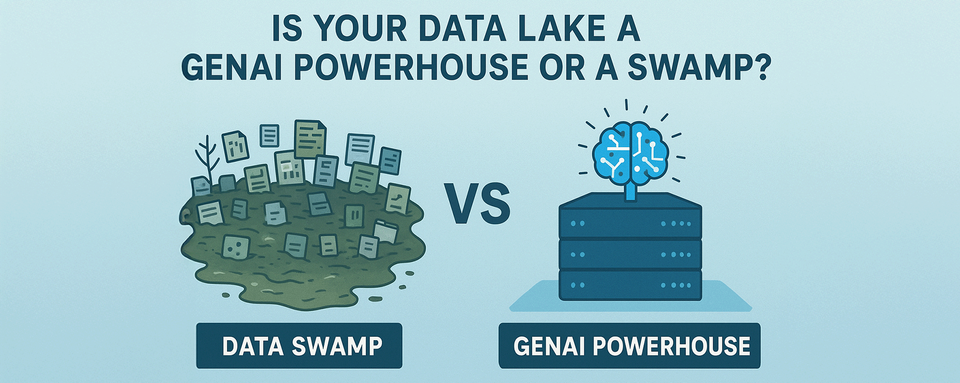
For what feels like a decade, we've been part of the chorus telling everyone to "store everything." We built massive Data Lakes, convinced that one day we'd figure out what to do with all that data. The mantra was "store now, analyze later."
In many cases, that "later" turned into "never." We became digital hoarders, and our prized data lakes started to feel more like data swamps; murky, disorganized, and costing a fortune to maintain.
Then, almost overnight, Generative AI showed up and called our bluff. "Later" is now. This article is my take on this shift; a straightforward blueprint for turning your biggest data headache into your most valuable asset.
Note: While my examples are drawn from the Azure ecosystem, the core principles of data hygiene, Retrieval-Augmented Generation (RAG), and integrated governance are universal and apply across any major cloud platform.
Quick-read, Visual Version
Your AI Strategy Starts in the Data Lake, Not the GPU Cluster
We've spent years obsessing over compute; the real bottleneck for enterprise AI has always been clean, accessible data.
The most significant mental shift we need to make is recognizing that the bottleneck for enterprise AI is no longer compute power; it's data. Specifically, it's high‑quality, relevant, and secure data. And for many of us, the single source of truth for that data, the good, the bad, and the ugly, is our Data Lake.
This isn't just about storage. It's about creating a solid foundation for reliable AI. What I'm seeing everywhere is that the go‑to pattern for enterprise GenAI is Retrieval‑Augmented Generation (RAG). In simple terms, RAG stops an LLM from making things up by giving it access to a private, curated knowledge base for answers (Retrieval Augmented Generation (RAG) in Azure AI Search; What is retrieval‑augmented generation (RAG)? - Cloudera). And where is that definitive, company‑specific knowledge base? It's sitting right there in your data lake.
Time to "Marie Kondo" Your Data Lake

If a piece of data doesn't spark a useful insight, you have to ask why you're paying to store it.
For years, we’ve treated our data lakes like storage units, continually adding new data without a clear strategy. Generative AI is finally forcing everyone to clean house. A good way to think about this cleanup is by calling this the "Marie Kondo" method for our data. We need to examine our data and ask, "Does this spark value… or at least a useful token for an LLM?"
This isn’t just a cute analogy. It addresses a massive, hidden cost. A considerable chunk of AI spend is wasted on data preparation and augmentation.
After this "tidying up", perform the following three practical steps:
- Embrace the Lakehouse: Consider combining the raw, flexible storage of a data lake with a transactional layer like Delta Lake. This gives you the scale to store anything, with the reliability and performance of a structured warehouse. You get the best of both worlds. (What is Delta Lake? Benefits and Architecture | Qlik | What is Delta Lake in Azure Databricks? )
- Tag Everything Automatically: Use tools like Microsoft Purview to scan and classify data the moment it lands. Is it PII? Is it financial data? This isn’t just a compliance task anymore; it’s a fundamental requirement for building safe RAG applications. (Learn about sensitivity labels in Microsoft Purview Data Map (preview))
- Track Your Data's Journey: You need automated lineage to see where your data came from and how it was transformed. If an AI gives you a surprising answer, you have to be able to trace it back to the source. It’s about trust and debuggability. (Automating Data Lineage with Azure Purview - Think AI Corporation)
Do this, and your data lake starts looking less like a messy closet and more like a well‑organized library, ready for your AI to use.
From Multi-Million Dollar Project to Manageable OpEx

A year ago, vectorizing your data lake was a budget‑killer; today, it’s a line item.
The first question a Technology leader always gets from the CFO and other leaders is, "This sounds expensive. What's it going to cost to index petabytes of data for vector search?" A year ago, we would have said, "It's complicated." Today, our answer is "It's surprisingly affordable."
Microsoft recently slashed the cost of vector indexing in Azure AI Search significantly. New services in the Basic and Standard tiers in select regions now have more storage capacity and compute for high performance retrieval of vectors, text, and metadata. On average, cost per vector is reduced by 88% and you’ll save on total storage costs per GB by up to 75% or more. (Announcing cost‑effective RAG at scale with Azure AI Search).
Suddenly, turning a huge portion of your data lake into a searchable knowledge base for your AI is no longer a multi‑million dollar fantasy. It’s a manageable operational expense (Azure AI Search pricing). The budget argument against RAG at scale is officially off the table.
From Messy Kitchen to an Integrated AI Factory

The best AI strategy is worthless if your teams are fighting the tools instead of solving the problem.
So, the data is getting clean, and the economics finally work. How do we actually build this thing? To make it concrete for the teams, we often need to switch analogies from a clean closet to a professional kitchen.
Suppose your tidy data lake is the pantry. In that case, something like Microsoft Fabric is the integrated, modern kitchen where everything comes together (Microsoft Fabric: What it is and how it uses AI to manage data). It pulls all the tools into one workbench. Your data engineers act as the prep chefs, using tools to chop and prep the data on demand. Your data scientists are the master chefs, using tools like Prompt Flow (Build high-quality LLM apps) to orchestrate the AI.
The whole process, from raw data to a finished AI‑powered insight, happens in one place. This integration drastically reduces the friction that we’ve seen kill so many promising AI projects in the past.
Governance Isn't a Feature, It's the Foundation

An AI that leaks confidential data isn't innovative; it's a liability waiting for a headline.
Let's be blunt: an AI‑powered application that leaks confidential data or says something toxic isn't innovation; it's a disaster. Governance and safety aren't nice‑to‑haves; they are non‑negotiable. Beyond the technical and legal fallout, the damage to customer trust and brand reputation can be irreversible. This makes proactive governance a non-negotiable foundation for any enterprise AI strategy.
From what we are seeing, the most effective architecture doesn't rely on slow, real‑time policy checks. Instead, it’s a two‑step process:
- At Indexing Time: As data is processed, Microsoft Purview automatically applies sensitivity labels. This metadata gets stored right alongside the vector embeddings in Azure AI Search.
- At Query Time: The application checks the user's permissions and injects them as a security filter directly into the search query. This way, the AI never even sees data the user isn't supposed to access.
And for safety, a service like Azure AI Content Safety is an absolute must. It acts as an airbag, checking both the user's prompt and the AI's response for harmful content. This isn't an optional add‑on; for any responsible leader, it's a requirement. Learn more at Implement generative AI guardrails with Azure AI Content Safety.
The Blueprint Is No Longer Theoretical
The world's biggest companies are already proving this model works at scale; the only question is when you will start.
When you put all these pieces together, the path forward is clear. Transforming a data swamp into an AI powerhouse is no longer a theoretical exercise. It's a practical, affordable, and secure strategy.
The proof is everywhere. In terms of large scale investment numbers in Gen AI - a couple of good examples are Coca‑Cola’s billion‑dollar strategy (Coca‑Cola & Microsoft Partner to Accelerate Cloud and Gen AI), and Walmart using GenAI, powered by its own massive data estate, to write product descriptions for millions of items (Walmart used AI to crunch 850M product data points - Retail Dive).
The blueprint is set: a well‑governed Data Lake, the RAG pattern to connect to LLMs, affordable Vector Search, efficient Serverless Compute, and an integrated platform like Microsoft Fabric, all wrapped in non‑negotiable layers of Governance and Safety.
What's Next on the Radar

The tech is mostly solved; the next great challenge is building a culture of data discipline to match.
This shift does more than just clean up data; it democratizes insight. Soon, anyone in the business will be able to ask complex questions in natural language and get answers grounded in real company data.
The next technical frontier is moving beyond text. Leaders are already looking at how these same principles can apply to search and reason over the images, audio, and video files sitting in their data lakes.
But the biggest unresolved question we are all grappling with is less about tech and more about people. We have the architecture for governance, but how do we build the organizational discipline to stop the lake from turning back into a swamp? That, in my opinion, is the real leadership challenge ahead.
The advice is simple: start now. Don't try to boil the ocean. Pick one high‑value dataset, give it the "Marie Kondo" treatment, and build a small RAG pilot. The lessons you learn will be worth their weight in gold.
It’s Time to Spark Innovation, Not Just Store Data
Stop seeing your data lake as a storage cost and start treating it as the engine for your next wave of growth.
The era of the passive data lake is over. Generative AI has provided both the tools and the urgent business case to finally unlock the value we've been sitting on for years.
By treating our data with intention, applying these proven architectural patterns, and taking advantage of the new economics of AI on cloud services like Azure, we can turn that swamp into a strategic asset. It's time to stop just storing data and start using it to spark real innovation.
Citations and Further Reading
- Coca‑Cola & Microsoft Partner to Accelerate Cloud and Gen AI
- Coca‑Cola pours $1.1B into Microsoft cloud, generative AI partnership
- 2024: The State of Generative AI in the Enterprise | Menlo Ventures
- Azure AI Search pricing
- AI‑Driven Azure Data Lake + [Industry Use Cases] - Polestar Solutions
- Automating Custom Data Classification and Tagging in Microsoft ...
- Automating Data Lineage with Azure Purview - Think AI Corporation
- Microsoft Fabric: What it is and how it uses AI to manage data
- All About Azure Synapse Serverless Computing - AlphaBOLD
- Azure AI Content Safety
- Implement generative AI guardrails with Azure AI Content Safety
- Walmart used AI to crunch 850M product data points - Retail Dive
- Retrieval Augmented Generation (RAG) in Azure AI Search

Comments ()