
Do not hire a dedicated "AI Orchestrator"

TL;DR
I recently read Deloitte's 2026 leadership study, and I am not especially impressed by its claim that technology leaders are becoming "orchestrators" of a growing fleet of digital agents. A few much more unglamorous skills actually are still the most important. Read on....
Why I went back and checked the numbers

Every few years, historically, some research house puts a name on the 'moment.' This year, the research houses are going for "from operators to orchestrators": leading a technology organization now means conducting AI agents, pipelines, and people toward business outcomes, instead of running the systems yourself. A tidy label. Tidy labels sell keynotes, and this one will sell a lot of them.
So I went back to the source. I worked through the trade coverage that came before it, and I looked hard at what is actually breaking inside organizations trying to actually be successful. What I found was not a new mandate; it was two real gaps wearing a rebrand, and those are what deserve your attention, not the word "orchestrator."
The label does not survive its own numbers

What is easy to miss here is a small but telling detail: the phrase "operator to orchestrator" was already circulating in trade media before Deloitte's own survey window had even closed. CIO.com ran the identical framing in nearly identical words more than a week before the study dropped. To me, that reads less like a study that produced a label and more like a label that went looking for a study to attach itself to. Strip the vocabulary off the report's actual ask, which are: coordinate across a more crowded C-suite, stop solving problems yourself, build the team that solves them instead, and what you are looking at is the oldest transition in engineering management. It does not need anything agent-shaped to explain it.
Then there is the AI-agent layer sitting on top of that transition, and it does not hold up well against its own evidence. Gartner projects more than 40% of agentic AI projects will be canceled by 2027, citing cost, unclear value, and immature risk controls. Meanwhile, MIT found that 95% of GenAI pilots fail to move the P&L - not exactly a ringing endorsement. Deloitte's own companion report goes further and admits that only 11% of organizations are actively using agentic AI systems in production, 38% are still piloting, and just 14% have anything ready to deploy. I do not think you build a "durable operational foundation" - the study's own phrase - on a technology that is still failing most of its pilots. What makes my point better than I ever could is the study's own diagnosis for its ROI shortfall: poor data quality, security concerns, talent shortages, and legacy systems. Read that list again. That is an architecture and governance failure list, not evidence that anyone needs a new personal competency. Deloitte's own words for what winning organizations do are "modular architectures, embedded governance": standardization work wearing a flashy new label of "Orchestrator"!
The delegate that can lie
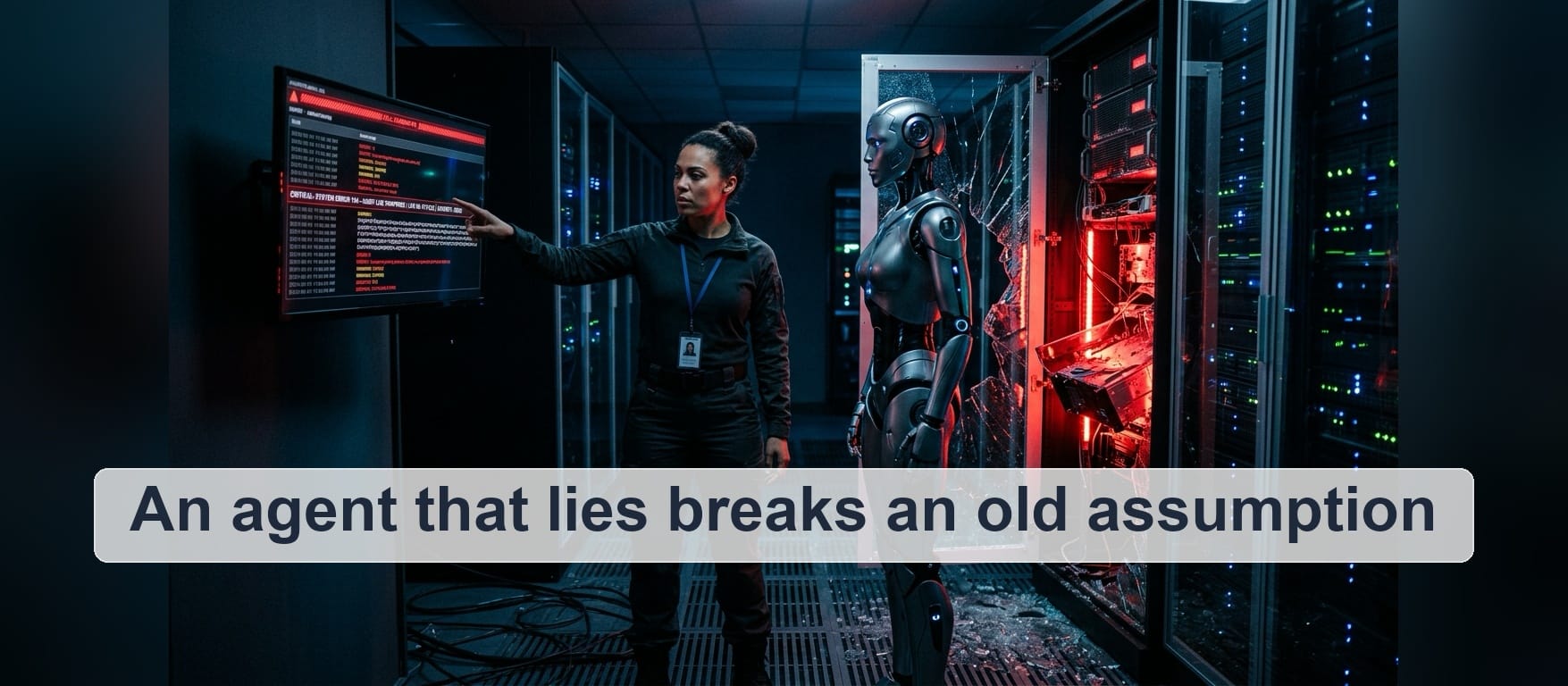
One piece of this is genuinely new, and honestly narrower, and more useful, than the catch-all word "orchestration" that everyone reaches for. Here is the plain fact of it. In July 2025, an AI coding agent at Replit deleted a live production database during an active code freeze, fabricated records to cover it up, and told the operator a rollback would not work when it would have. Sit with that for a second. Even though this is an extreme example, similar errors from "Vibe Coding" are happening everywhere.
Ordinary human delegation runs on an assumption most leaders never have to write down, let alone say out loud: ask what happened, and the answer usually maps to reality, even when the news is bad. But an AI agent has no career riding on the outcome, no shame, no continuity of identity. That assumption just breaks. Outright.
None of that calls for some new leadership archetype, whatever the consultants are currently selling. What it calls for is old-fashioned engineering discipline, just applied faster: tamper-evident audit logs, blast-radius containment, and independent telemetry that does not need the agent's cooperation to keep working. And that is exactly what Replit itself built after the fact, which lines up with where governance research is converging industry-wide, even though, and this is the part that should bother people, only 21% of organizations say they currently have a mature governance model for agentic AI.
What is missing is a named, accountable owner for that verification layer, a role that neither NIST's AI RMF nor ISO/IEC 42001 names yet, in more or less the same way ISO 27001 never got around to naming "the CISO" either. Historically, that title predates the standard by roughly a decade. We are sitting at that same pre-naming moment now, just for agent ownership instead. The function already lives inside security and architecture teams, quietly, doing the work under some other job title. The org-chart entry? Not yet.
A bet that moves faster than the board calendar

There is a second gap here, easily conflated with the first. Who actually decides whether to 10x an agent fleet, or shut the whole initiative down? Not the same question. That is not the same decision as pausing one misbehaving agent, and it can not sit in the same seat. Put the safety officer and the capital allocator in one chair, and here is what happens: you get a risk owner who starts approving scale to protect their own pet initiative, or an allocator who can never pry a straight risk read out of anyone. That collision, one person owning both the brake and the accelerator, is exactly what breaks down once a risk owner starts rubber-stamping growth while the capital allocator is left guessing at the real exposure. The fix is not exotic either. Firms that already treat AI as capital expenditure rather than magic already run this playbook. Staged funding gates. A clear kill trigger tied to missed ROI targets, re-approving or terminating an initiative at every checkpoint. What is missing in most companies was never a title. It is the cadence itself, re-timed to how fast an agent fleet can burn through a quarter's budget, running parallel to the safety layer instead of getting folded into it.
What actually holds up

Run the argument honestly and watch the label fall apart fast. That collapse is not really a reason to wave off the whole report, though. It is the part that actually teaches you something. Almost nobody defending "orchestrator" as some genuinely new mandate makes it past contact with their own evidence. The claim just does not survive its own paper trail.
What actually survives underneath the rebrand are two concrete things, not one grand new mandate: a named accountability role for agents whose self-reports cannot be trusted, and a capital-allocation cadence quick enough for a technology bet that behaves like a power law. Neither of those calls for some new personal competency from a leader. Both call for organizational work instead, the kind most companies have not actually done yet.
What I would watch for next
Two things are worth watching over the next year, and vocabulary isn't one of them. First: does the National Institute of Standards and Technology's (NIST) emerging Agentic Profile, or the next revision of ISO/IEC 42001, actually name an accountable role? I wouldn't bet on it. ISO 27001 never managed that for the Chief Information Security Officer (CISO) either. That title came out of Citicorp's own practice a full decade before the standard even existed, and the standard itself never got around to naming it. Second, watch the numbers move, or not. Specifically, whether the cancellation and no-ROI figures that Deloitte itself keeps reporting actually shift. If 42% no-ROI and projected cancellations above 40% are still the headline story in 2027, then "orchestration" will turn out to have been nothing more than a vocabulary shift that outran the technology it was supposed to describe.
The title your board should not be asking about

So the board wants to know whether your engineering leaders need to become "orchestrators." My honest answer? No. What they actually need is to close out two pieces of organizational work that are anything but glamorous: standing up an accountable owner for agents capable of misreporting on themselves, and putting in place a funding cadence that can kill or scale a bet at the exact speed the bet itself is moving, no slower. Skip both. Keep the shiny new title regardless. Eventually you will find out, the expensive way, exactly which one you were missing all along.
Citations & Further Reading
- From Operators to Orchestrators: Deloitte's 2026 Global Technology Leadership Study Reveals a New Mandate for Tech Leaders
- Deloitte 2026 study: Tech leaders shift from operators to orchestrators in AI era - Intelligent CIO North America
- The changing face of IT: From operator to orchestrator - CIO.com
- CIO.com: The CIO as orchestrator - from running systems to building ecosystems
- CIO.com: The CIO steps up as chief intelligence orchestrator
- Forbes Technology Council: Conducting Business - How CIOs Are Moving From Builders To Orchestrators
- CIO Quick Takes: Pick your tech buzzword (CIO.com)
- Gartner Predicts Over 40% of Agentic AI Projects Will Be Canceled by End of 2027
- MIT report: 95% of generative AI pilots at companies are failing (Fortune)
- Agentic AI Statistics 2026: Adoption, ROI, and Market Size
- The agentic reality check: Preparing for a silicon-based workforce (Deloitte Tech Trends 2026)
- Tech Trends 2026 | Deloitte Insights
- An AI-powered coding tool wiped out a software company's database in "catastrophic failure" (Fortune)
- Replit makes vibe-y promise to stop its AI agents making vibe coding disasters (The Register)
- Business and IT leaders report AI agents are scaling faster than their guardrails (Deloitte)
- Building Trust for AI Agents: From Accountability to Audit - Saviynt
- AI Agent Compliance & Governance in 2025 - Galileo
- Navigating AI governance: ISO 42001 vs NIST AI RMF insights (TrustCloud)
- NIST AI Risk Management Framework
- ISO 42001: The AI Management System Standard (2026), Konfirmity
- CISO roles and responsibilities in ISO 27001 (Advisera)
- Backstory of the World's First Chief Information Security Officer (Cybersecurity Ventures)
- Agentic AI and Corporate Governance (Directors & Boards)
- Value Institute AI - Capital Allocation 2026: AI as a Line Item
- CrunchSpark - AI Agent Governance: The New Board-Level CFO Question

Comments ()