
Your OCR is Lying to You: Unlocking True Document Intelligence with Multimodal AI
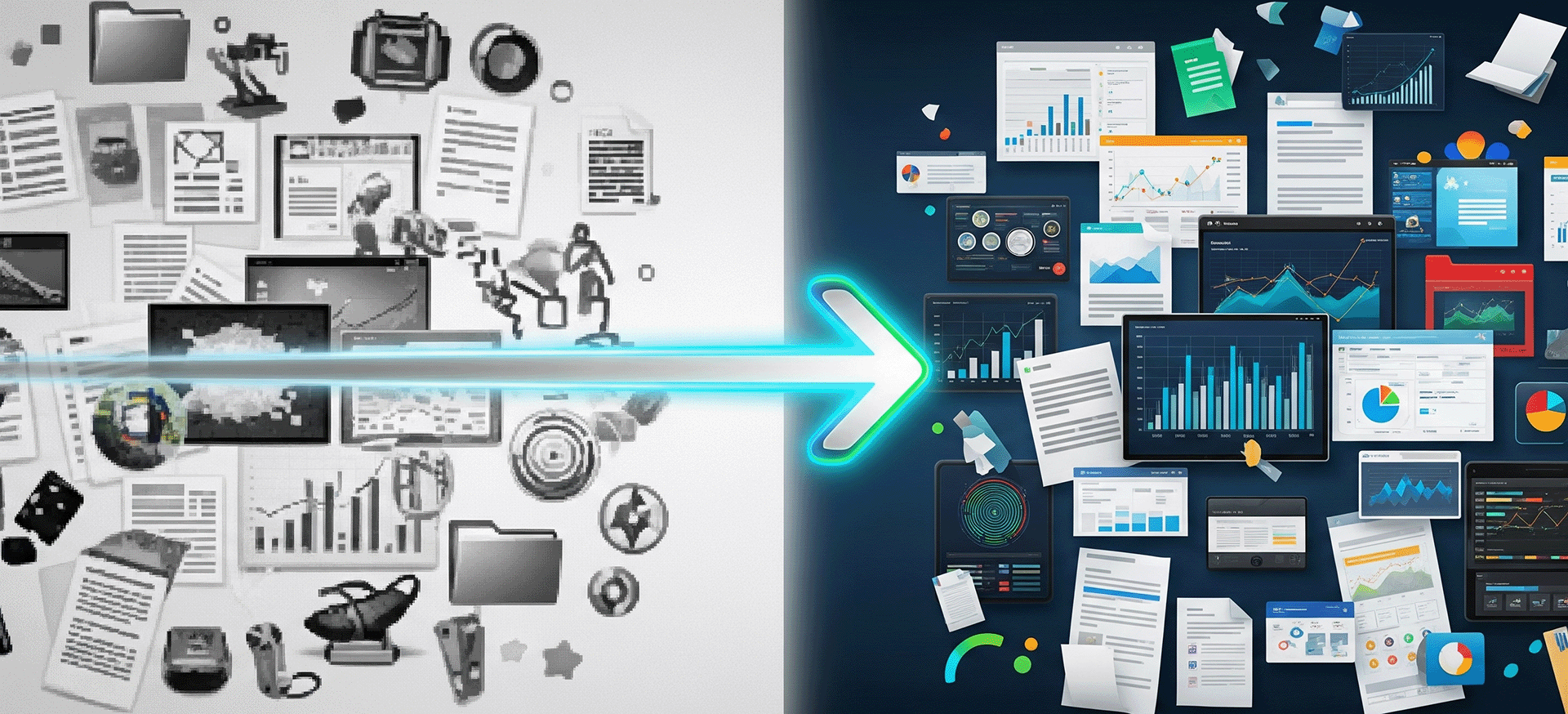
For years, we’ve treated Optical Character Recognition (OCR) as the default solution for digitizing documents. It’s a workhorse, no doubt, but it’s a workhorse with blinders on. In my experience, standard OCR reads the text but misses the story: the layout, the logos, the signatures, the tables. This “context gap” isn’t a minor inconvenience; it’s a source of operational friction and costly errors.
If traditional OCR is a black-and-white TV, dutifully showing you the script, then Multimodal AI is the full 4K experience. It sees the entire scene: the words, the layout, the visual cues. It understands the whole picture.
This article is for the leaders and engineers who are tired of their systems making black-and-white decisions in a full-color world. My goal is to strip away the hype and give you a clear-eyed look at the technology, its real-world business impact, and how to actually get it into production.
Quick-read, Visual Version
The OCR Glass Ceiling: Why Reading Isn't Understanding

We’ve spent years patching OCR with complex rules, but you can't fix a perception problem with a better script.
For decades, we’ve accepted OCR’s limitations as the cost of doing business. It operates on a simple premise: turn pixels into characters. In doing so, it discards a huge amount of information that any human would use to understand a document instantly.
- It’s Blind to Layout: OCR flattens everything into a stream of text. It has no idea that a number in a column labeled "Total" is more important than a number in the letterhead's address. The spatial relationship is lost.
- It Ignores Visual Context: Logos, signatures, stamps, and watermarks might as well be invisible. This context isn't just decoration; it’s often critical for verification and accuracy.
- It Chokes on Complexity: Throw a complex table, a multi-language document, or a form with checkboxes at a standard OCR engine, and you’re likely to get a mess of jumbled data. This inevitably leads to higher error rates and more manual cleanup. (Major limitations Of OCR technology and how IDP systems overcome them).
We've been putting digital band-aids on these systems for years with complex rules and templates. But it's a losing battle. The real solution isn't a better patch; it's a fundamentally better approach.
The Real Breakthrough: Models That See and Read

The real magic isn't just better text recognition; it's giving the AI eyes to understand context, just like a human does.
The breakthrough we're seeing now comes from combining computer vision and natural language processing into a single architecture: the Multimodal Document Transformer. What is impressive about models like LayoutLMv3 or OpenAI's GPT-4o is that they don't just process text; they ingest the entire document page as an image. They learn the intricate dance between the words and their positions.
This works through a surprisingly powerful process called unified text-image pre-training. The model learns to fill in missing words based on the layout and to predict missing parts of the image based on the surrounding text. This gives it a foundational understanding of both what a document says and how it looks. (Vision Language Models: Moving Beyond OCR's Limitations).
The field is moving fast, and here’s what to keep your eye on:
- Specialized Models: Open-source models like DocFormer and its successors are purpose-built for this, combining text, vision, and layout features for better document understanding. (DocFormer uses text, vision and spatial features).
- Foundation Models: Heavy-hitters like GPT-4o and Gemini can now perform these tasks with surprisingly little custom training, which is a game-changer for rapid prototyping.
- Architectural Evolution: I’m also seeing promising results from new models using "late-fusion" techniques, where text and layout are processed separately before being combined. This seems to handle highly complex documents more effectively. (DocLLM: A layout-aware generative language model for multimodal document understanding).
From Lab to Ledger: What This Means for the Bottom Line

Stop measuring document processing in cost-per-page and start measuring it in the cost-of-error.
This isn't just an interesting academic exercise; it's fundamentally changing the economics of document workflows. What I'm seeing in the field is that AI-powered document solutions are leading to a steep drop in errors, processing time, and the sheer amount of manual work required. (Is AI in Document Workflows Worth It? Here’s the ROI Breakdown).
The ROI isn't just about cutting a few headcounts. It's about:
- Operational Efficiency: Reducing the human-in-the-loop exception handling that slows down everything from accounts payable to customer onboarding.
- Risk Reduction: Minimizing the kind of costly mistakes that come from misinterpreting data, which also has a significant impact on compliance and auditability.
The Engineer's Blueprint: A Practical Guide to Implementation
The best strategy balances cutting-edge models with the practical needs of security, latency, and auditability.
So, how do you actually put this to work? If I were talking to my engineering leads, here's the playbook I'd give them:
- Rethink the Data Pipeline: Your pipeline starts with raw PDFs and images. I suggest using a basic, lightweight OCR engine not as your final answer, but as a "hint provider" to the multimodal model. You’ll need to store both the document images and the layout metadata to feed the model correctly.
- Choose Your Deployment Model Wisely:
- Build for Trust and Auditability: This is critical. Your system must be able to show its work. For any piece of data it extracts, it should provide visual evidence, like the bounding box coordinates on the original document. This allows a human to quickly verify low-confidence results without having to hunt for the source.
Green Document AI: An Unexpected Win

Smart implementation isn't just about performance; it's about being efficient with our resources, including energy.
A fair question we often get is about the environmental cost. We've all heard stories about the massive energy consumption required to train large models. While that's true, there's a big difference between training from scratch and deploying an application. (Lower Energy Large Language Models (LLMs)).
Here’s how we approach it responsibly:
- Fine-tune, Don’t Train from Scratch: Fine-tuning an existing model for your specific documents uses a tiny fraction of the energy required to train it initially.
- Use Model Quantization: Running inference with reduced-precision models (e.g., 8-bit integers instead of 32-bit floats) significantly cuts the computational load and energy draw.
- Deploy on Sustainable Clouds: Choose your cloud provider carefully. Select providers that have a public, verifiable commitment to using renewable energy. (Preventing the Immense Increase in the Life-Cycle Energy and ...).
The Future is a Living Document
We're moving from static, dead documents to living, interactive sources of intelligence.
What excites me most is where this is heading. We're on the cusp of having AI that can truly reason over the combination of images, text, and data within a document. The dream of the "living document": one that is interactive, searchable, and intelligent is finally becoming a practical reality.
Conclusion: It's Time to Upgrade Your Reality
The shift from basic OCR to Multimodal AI isn't just an incremental upgrade; it’s a fundamental change in how we interact with information. By embracing models that can both see and read, we can finally eliminate the costly blind spots that have plagued our systems for years.
For any leader staring down a mountain of paperwork or fighting fires caused by bad data, the message is simple: stop settling for the black-and-white summary. The future of document intelligence is in full color, and it’s already here.
#DocumentAI #MultimodalAI #OCR #AITransformation #Automation #EnterpriseAI #DigitalTransformation #AIROI #SustainableAI #MachineLearning
Citations and Further Reading
- Major limitations Of OCR technology and how IDP systems overcome them
- Vision Language Models: Moving Beyond OCR's Limitations
- DocFormer uses text, vision and spatial features
- DocLLM: A layout-aware generative language model for multimodal document understanding
- Is AI in Document Workflows Worth It? Here’s the ROI Breakdown
- Lower Energy Large Language Models (LLMs)
- Preventing the Immense Increase in the Life-Cycle Energy and ...



Comments ()