
Build AI Roadmaps That Survive CFO Review

AI budgets now need proof, not poetry.
A B2B data analytics company has just celebrated the 6 month mark of the launch of their new feature, “Ask Your Data”!
Usage was ‘off the charts’. It was being talked about positively by customers in renewal conversations, all the sales teams were using it in all the demos. Product had all the screen shots of ‘Ask Your Data’ in action. Marketing had all the great sound bites from happy customers. Another great feature and everyone loves it.
Then finance looked at the unit economics.
The biggest users were becoming the least profitable customers. As usage increased, the compute cost to support the heaviest users grew with each happy prompt. And each deeper question by customers or employees triggered even more Retrieval, Inference, Evaluation and – margin leakage.
That is the AI product trap.
I do not believe the CFO is the enemy of innovation here. In fact, the scrutiny the AI initiatives are getting from the CFO is the first “adult supervision” that the AI roadmaps have received. This is a very healthy thing. The first wave of generative AI initiatives to market have focused on getting something out the door, building cool demos to show senior executives in the company, and getting something to stick to the wall. The next wave of innovation requires a level of operating discipline that simply does not exist today.
The boardroom question has changed.
It is no longer, "Do we have an AI strategy?"
It is, "What return are we getting on this spend, and can we prove it?"
That is a much better question.
From Feature Theater to Operating Discipline

A roadmap full of AI features is not a strategy until it explains cost, risk, and payback.
The first generation of AI Roadmaps often looked like a menu.
Chat with your data. Summarize this. Generate that. Recommend the next action. Add an assistant to every screen. Sprinkle some "agentic" language on top and call it transformation.
I understand why it happened. The technology moved fast; Executives were excited, and competitors were making noise. Nobody wanted to look slow.
However, the easy demo phase is ending.
AI spending is rising fast. Gartner Says Worldwide AI Spending Will Total $2.5 Trillion in 2026. At the same time, Enterprise buyers are getting more disciplined. The 2025 AI Adoption Report: Gen AI Fast-Tracks Into the Enterprise shows leaders moving from stories and pilots toward benchmarks and measurable outcomes.
That shift matters.
Finance does not want a list of features; instead, finance wants a Portfolio. Each AI investment needs a category, a cost profile, a payback window, and a proof standard. I like to frame the Portfolio using a simple model inspired by Gartner's Objective Tagging: Gartner's Run / Grow / Transform Model:
- Run: AI capabilities already in production. This includes Inference, Observability, maintenance, model updates, Evaluation, and support. These costs should be judged against efficiency, reliability, and gross margin impact.
- Grow: Extensions of proven AI features into new workflows, customer segments, or premium tiers. These investments should be judged by attach rate, payback period, expansion revenue, and retention lift.
- Transform: Longer horizon Platform bets, such as Agent infrastructure, proprietary data loops, automation layers, and new product lines. These should be judged by milestone progress, option value, and strategic leverage.
The mistake is mixing these together and asking for one big AI budget.
That is how weak bets hide behind strong ones.
Why AI ROI Is Harder Than SaaS ROI

AI breaks the neat SaaS math because usage and cost no longer move in a straight line.
Classic SaaS has a beautiful financial story when it works. Add seats; expand accounts, and keep gross margins high. Infrastructure cost grows, but usually in a manageable way.
AI makes that messier.
A seat is no longer just a seat. A user can ask one simple question or run a chain of expensive tasks all day. One Customer may use the AI feature lightly; another may hammer it like a free research analyst with no lunch break.
Every action can trigger a stack of costs:
- Inference calls
- Retrieval
- Reranking
- Vector database usage
- Evaluation
- Guardrails
- Logging
- Human review
- Error handling
This is where CFOs get nervous, and they are not wrong.
A fixed subscription with uncapped AI usage can become a quiet margin challenge. It feels fine in the demo, and it feels great in adoption charts; however, the heavy-user cohort eventually shows up in the gross margin report.
Ouch.
There is also a timing issue. AI ROI often has a J-curve. In support Automation, for example, the first 90 days may not show savings at all. You may see higher cost because Teams need quality assurance, exception handling, workflow tuning, and rework.
That does not mean the project is bad.
It means the business case needs to admit reality. If the old workflow stays the same and AI is just pasted on top, you have not automated the work. You may have moved work from a support Agent to a reviewer, analyst, or escalation queue.
That is not transformation. That is cost relocation.
Workflow Redesign Is the Real Lever
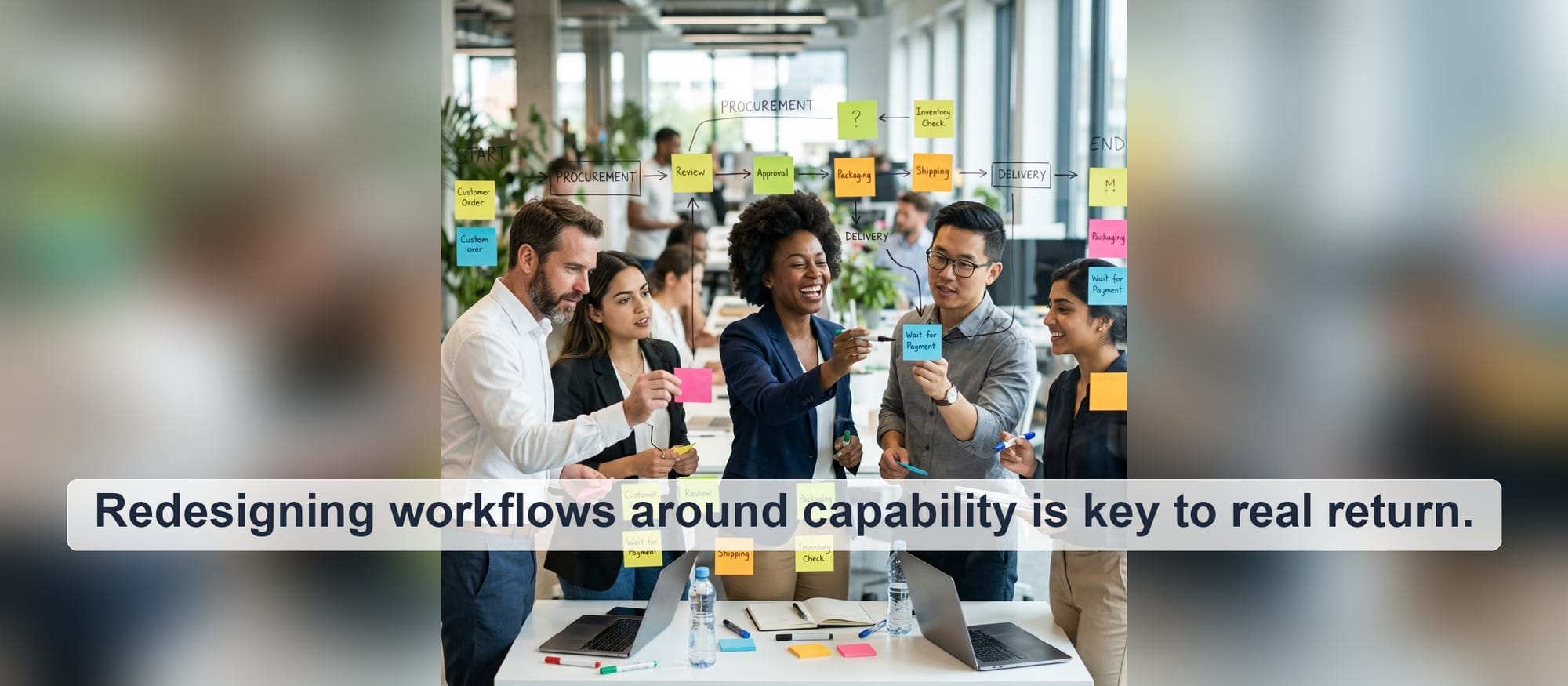
The return comes less from smarter tools and more from changing how work gets done.
This is the part many Teams skip because it is hard.
Adding AI to an old process is easy. Redesigning the process around new capability is political, operational, and sometimes uncomfortable; indeed, it changes roles, metrics, and handoffs. It may expose work that was never well designed in the first place.
However, that is where the money is.
I have become skeptical of AI projects that do not name a Workflow Owner. Not a Product Owner; not an Engineering Owner, but a Workflow Owner: someone accountable for how the work changes after the AI capability goes live.
Without that person, AI often becomes expensive autocomplete bolted onto yesterday's process.
The research backs this up. According to The state of AI in 2025: Agents, innovation, and transformation, only about 21% of generative AI adopters have fundamentally rebuilt workflows, yet that behavior is strongly linked with EBIT impact.
That is a big signal.
Before funding an AI project, I would ask a few plain questions:
- What work will stop happening?
- What steps will be removed?
- What decisions will move closer to the Customer?
- What manual review remains, and why?
- Who owns the operating change?
- What metric proves the workflow is better?
If the answer is only, "Users will save time," I would push harder.
Saved time is slippery. Redeployed capacity is better; reduced cycle time is better, and lower cost per completed task is better. Higher renewal rate is much better.
Treat AI as a Portfolio of Bets

Not every AI investment deserves the same patience, budget, or success metric.
One of the fastest ways to lose credibility with finance is to defend every AI project with the same logic.
Some projects should pay back quickly; others should earn patience because they open a new strategic path. Some should be killed early because the economics never worked.
That is not pessimism. That is Portfolio management.
Here is the simple framework I find useful.
Productivity Automation
- Payback horizon: 6 to 18 months
- Primary metric: Cost per unit of work, hours redeployed, manual effort avoided
- Risk level: Low to medium
- Kill criterion: No measurable unit-cost reduction after 6 months of stable use
These projects should not require heroic storytelling. If the AI is meant to reduce manual work, show the before and after; if the baseline is fuzzy, fix the baseline before asking for more budget.
Product Differentiation
- Payback horizon: 12 to 30 months
- Primary metric: Attach rate, retention lift, expansion revenue
- Risk level: Medium
- Kill criterion: Less than 15% attach rate or no retention lift after 12 months in market
These bets need Customer proof; they do not need internal excitement or demo applause. Real willingness to adopt, renew, expand, or pay is what matters.
Strategic Platform Bets
- Payback horizon: 24 to 48 months
- Primary metric: Data coverage, Evaluation coverage, cost per task, Platform reuse
- Risk level: Medium to high
- Kill criterion: Failure to hit two consecutive stage-gate milestones
These are the hardest to defend, and sometimes the most important. The key is not to pretend they have near-term ROI; instead, give them milestones, gates, and a serious review process.
One footnote matters.
A Productivity Automation project without a committed Workflow Redesign Owner is not low risk. It is medium risk at best.
The Metrics That Matter

AI button clicks are not value. They are curiosity with a dashboard.
I see too many AI Dashboards filled with activity metrics.
Prompts submitted. Summaries generated. Assistant sessions. Feature clicks. Tokens consumed.
Interesting? In my opinion, it is.
Useful for a CFO review? Not really.
Adoption matters, but it is the first rung of the ladder. A user can try something because it is new, shiny, or because the Chief Executive Officer (CEO) mentioned it at the all-hands; however, that does not mean it changed the business.
The Metrics need to move up the value stack:
- Adoption: Activation rate, repeat usage, user reach Are people trying it more than once?
- Task success: Completion rate, correction rate, retry rate, fallback rate Is the AI actually helping users finish the job?
- Workflow impact: Cycle time reduction, fewer manual touches, lower escalation rate Is the way work gets done improving?
- Unit economics: Cost per successful outcome, AI COGS, heavy-user profitability Does usage make the business stronger or weaker?
- Commercial impact: Attach rate, retention lift, expansion revenue, NRR movement Are Customers paying, staying, or expanding because of it?
The heavy-user profitability metric deserves special attention.
Average usage hides danger. The 90th percentile user tells you whether your packaging survives real enthusiasm; I would rather find that out in a pilot than after the Sales Team has promised unlimited AI to every Enterprise account.
Internal-First Is Not the Whole Strategy

Internal AI projects should build muscle, not become a comfortable hiding place.
Many leaders advise starting with internal AI use cases. I agree, with one condition.
Internal-first is a tactic; it is not a strategy.
Internal projects can be a good training ground. They help Teams build Evaluation practices, Observability, cost monitoring, security patterns, prompt management, and model Governance. That work is valuable; indeed, it reduces risk before Customer-facing launches.
However, internal AI work can also become a soft landing zone where nobody has to face pricing, packaging, Customer trust, or renewal impact.
That is a challenge.
An internal project should be a gym, not a sandbox. You go there to build strength; you do not live there forever.
A better rule is measurable-first. Start where the baseline is clear, the blast radius is controlled, and the outcome ties to a P&L lever. Sometimes that will be internal; sometimes it will be Customer-facing. The deciding factor should not be comfort; it should be measurability.
Pricing and the Gross Margin Reset
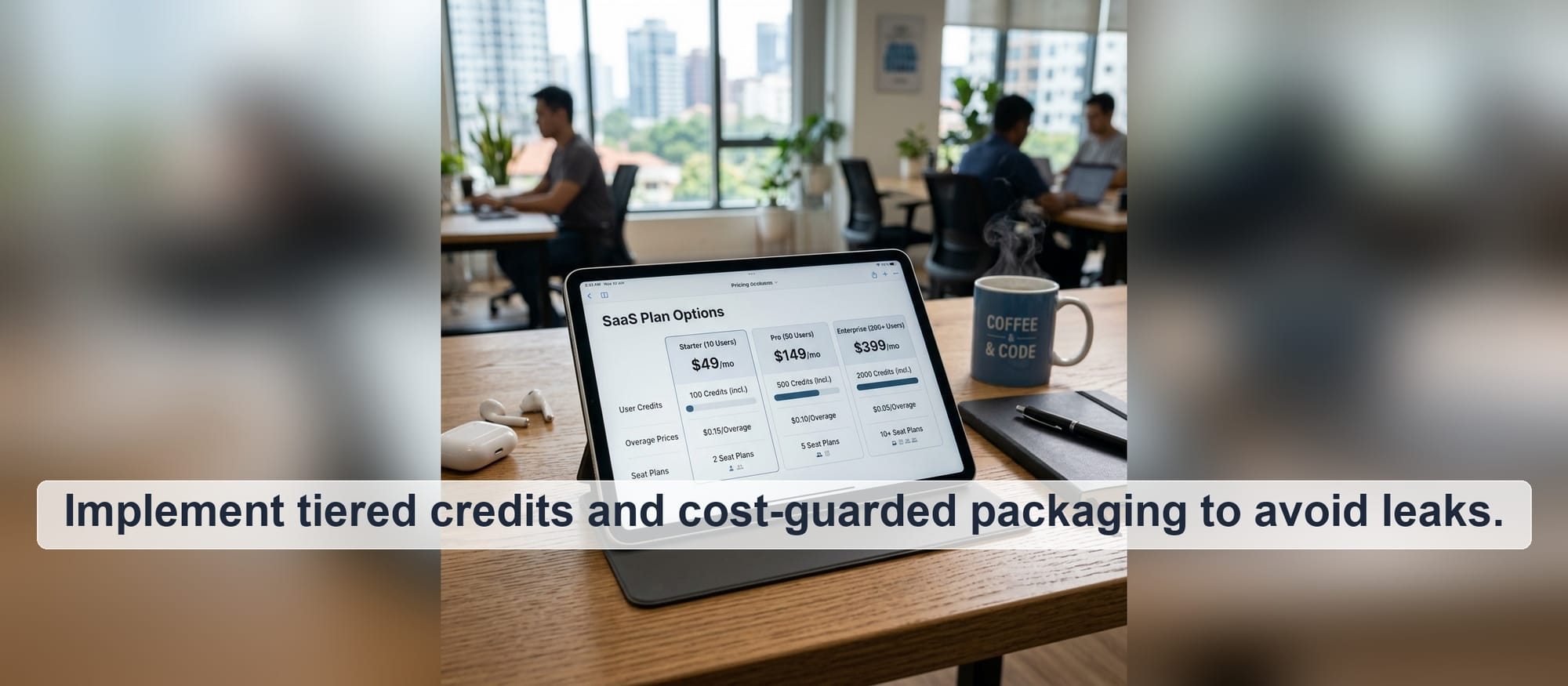
Unlimited AI sounds generous until your best customers start using it exactly as promised.
The CFO conversation gets serious when pricing enters the room.
Some operators, including The AI project gross-margin reset every SaaS company is about to..., warn that AI-heavy SaaS companies could see gross margins reset from the classic 80% range down to 60 to 70%. That may not happen evenly across the market; indeed, companies with strong pricing discipline and good cost controls may manage the pressure better.
Still, the risk is real.
The worst move is bundling unlimited AI into flat-fee plans without guardrails. It feels Customer-friendly, and it may help adoption early. However, if usage scales faster than revenue, you have created a margin leak and called it product love.
Pure usage-based pricing has its own issue; many B2B buyers dislike unpredictable bills. They want control, budget clarity, and fewer surprises from procurement.
The practical middle ground is cost-guarded packaging:
- Seat-based plans for predictability
- Tiered AI credits for fairness
- Overage pricing for heavy use
- Premium tiers for high-value workflows
- Admin controls so Customers can manage consumption
- Cost visibility so finance Teams are not surprised
This also changes how I believe about the argument that Inference is the new CAC. As Inference is the New Sales & Marketing Spend - SaaStr notes, in some viral-first companies, Inference spend may behave like marketing spend.
For most B2B SaaS companies, I would be careful with that idea.
Inference can be the new CAC only if it truly reduces CAC. If it improves conversion, shortens sales cycles, or creates product-led expansion, fine; measure it that way.
If not, it is just COGS wearing a very optimistic hat.
CFO Red Flags to Catch Early
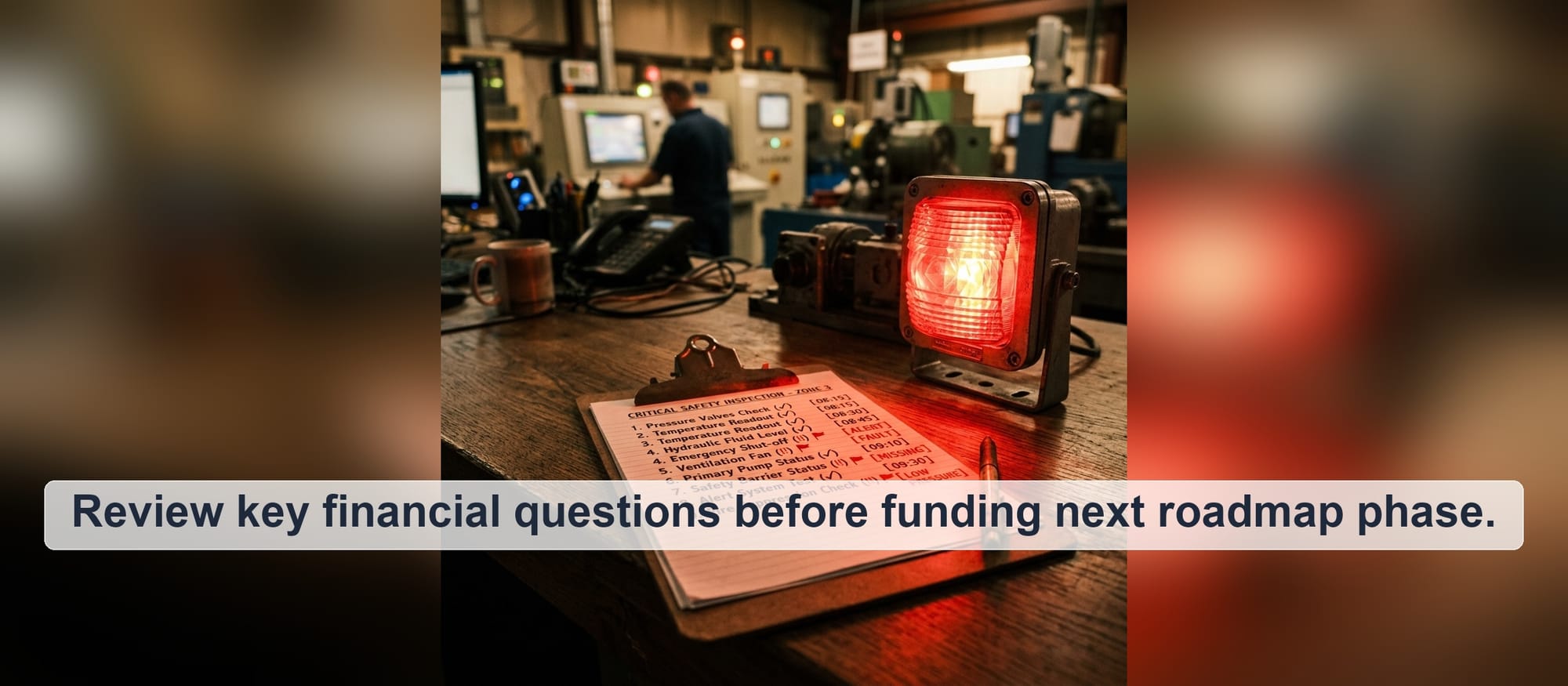
If the roadmap cannot answer basic finance questions, it is not ready for funding.
I like simple checklists because they cut through theater.
If an AI Roadmap shows any of these signs, I would slow down before the next budget ask:
- The Team shows adoption metrics but not cost per successful task.
- The pilot has no baseline metric or control group.
- There is no named owner for Workflow Redesign.
- The pricing plan is, "We will monetize it after adoption."
- The cost model uses average usage but ignores 90th percentile heavy users.
- The success metric is engagement, not P&L impact or renewal behavior.
- There is no kill criterion before the next budget tranche.
- The Roadmap treats all AI bets as if they have the same payback window.
- The Team cannot explain what human work will be removed, reduced, or changed.
- The business case assumes model costs will keep falling but does not model what happens if they do not.
None of these red flags mean the idea is bad.
They mean the idea is underwritten poorly.
That distinction matters. Good ideas die when they are packaged with weak economics; conversely, average ideas get funded when they sound strategic. Neither outcome is healthy.
Building the Fundable AI Roadmap

CFO scrutiny is not where serious AI ideas die. It is where they become real businesses.
The DORA | State of AI-assisted Software Development 2025 makes a point that I believe applies far beyond Software Engineering: AI does not fix a weak system. It amplifies what is already there.
Strong Teams get faster.
Fragile Teams create defects faster.
The same applies to AI product strategy. A strong Roadmap, tied to measurable outcomes, thoughtful packaging, workflow redesign, and clear economics, will benefit from AI; conversely, a weak Roadmap will not become strong because the feature list includes Agents, copilots, or natural language search.
It will just become more expensive.
I am not arguing for smaller AI Roadmaps. That would be the wrong lesson. Companies should still make bold bets; the opportunity is real, and the competitive gap will widen between Teams that learn how to apply AI well and Teams that only decorate products with it.
However, bold does not mean vague.
A fundable AI Roadmap should answer five questions clearly:
- What business outcome are we buying?
- What workflow will change?
- What will it cost at average and heavy usage?
- How will we price or package it?
- When do we scale, stop, or rethink the bet?
That is the level of discipline AI now deserves.
The age of AI experimentation is not fully over, but the free pass is gone. The next phase belongs to Teams that can connect imagination with unit economics.
That may not sound as exciting as a flashy demo.
It is much more useful.
Sources and Further Reading
Good AI strategy needs both judgment and evidence.
- The 2026 AI product strategy guide - Mind the Product
- 2025 The State of Generative AI in the Enterprise - Menlo Ventures
- 2025 AI Adoption Report: Gen AI Fast-Tracks Into the Enterprise - Wharton
- 72% of execs have ROI metrics for generative AI: Wharton - CFO Dive
- The state of AI in 2025: Agents, innovation, and transformation - McKinsey
- Announcing the 2025 DORA Report: State of AI-Assisted Software Development - Google Cloud
- Inference is the New Sales & Marketing Spend - SaaStr
- The AI project gross-margin reset every SaaS company is about to face - SFAI Labs
- 2025 Generative AI in Professional Services report summary - Thomson Reuters
- AI ROI Measurement Framework: 7 CFO-Grade Models 2026 - Digital Applied




Comments ()