
What World Cup 2026 Teaches About AI Trust

Summary
World Cup 2026 is a live test of machine evidence, human judgment, and public trust at ridiculous scale.
The 2026 World Cup is not merely a football tournament. Rather, it represents a highly public, real-time trial of human and machine decision-making operating under intense pressure.
I do not view this as a simplistic narrative about robots replacing human referees. That is the lazy version of the story. The far more compelling scenario is about something much harder: how we construct a governed, secure, and explainable system where machines collect evidence and humans retain final authority.
That distinction matters.
The official match ball, computer vision cameras, connected sensors, video assistant referee (VAR) rooms, broadcast graphics, betting markets, stadium network infrastructure, fan applications, and cybersecurity controls are now all links in one messy, interconnected trust chain. If a single component fails, the public likely will not care whether the failure was technical, procedural, or human. They will simply conclude that the entire system cannot be trusted.
In my opinion, that situation should feel very familiar to anyone currently building Enterprise AI systems in business.
Introduction: The Ball Is Now a Device
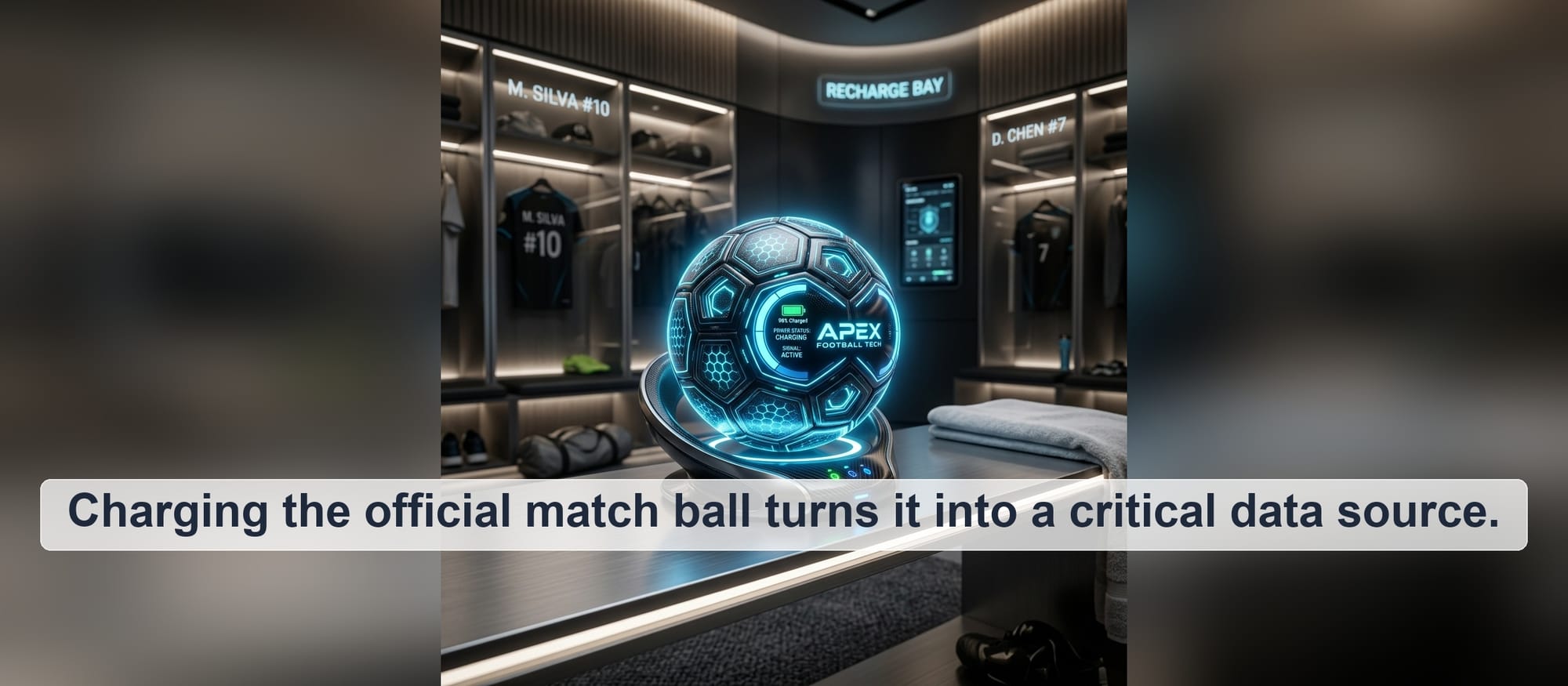
Once the ball needs charging, the game becomes part sport and part distributed system.
The official match ball for the 2026 World Cup, the Adidas Trionda, needs to be charged before every match.
That sentence still feels odd to write.
A football. On a charger!
The ball includes a 500Hz motion sensor and reportedly requires about 90 minutes of wireless charging to provide six hours of active use. This is not a marketing toy; rather, it helps identify the precise moment of contact, which remains one of the most disputed inputs in offside decisions.
So the ball is no longer just a ball. It has become a data source.
Consequently, that changes the trust model completely. Somewhere in the pipeline between the charging cradle, the sensor, the receiver, the camera system, the VAR room, the assistant referee, and the stadium screen, a chain of evidence is constructed. Each link must work. Each link must be protected. Each link has to be explainable enough that fans do not feel cheated.
This is precisely why I believe the World Cup example is useful for technology leaders. It strips away the boardroom gloss. There is no soft launch here. No quiet beta phase. No polite internal pilot with twenty friendly users.
Instead, we have a referee, a sensor, an API, and billions of passionate fans ready to shout at the screen.
Jurisdiction, Not Replacement
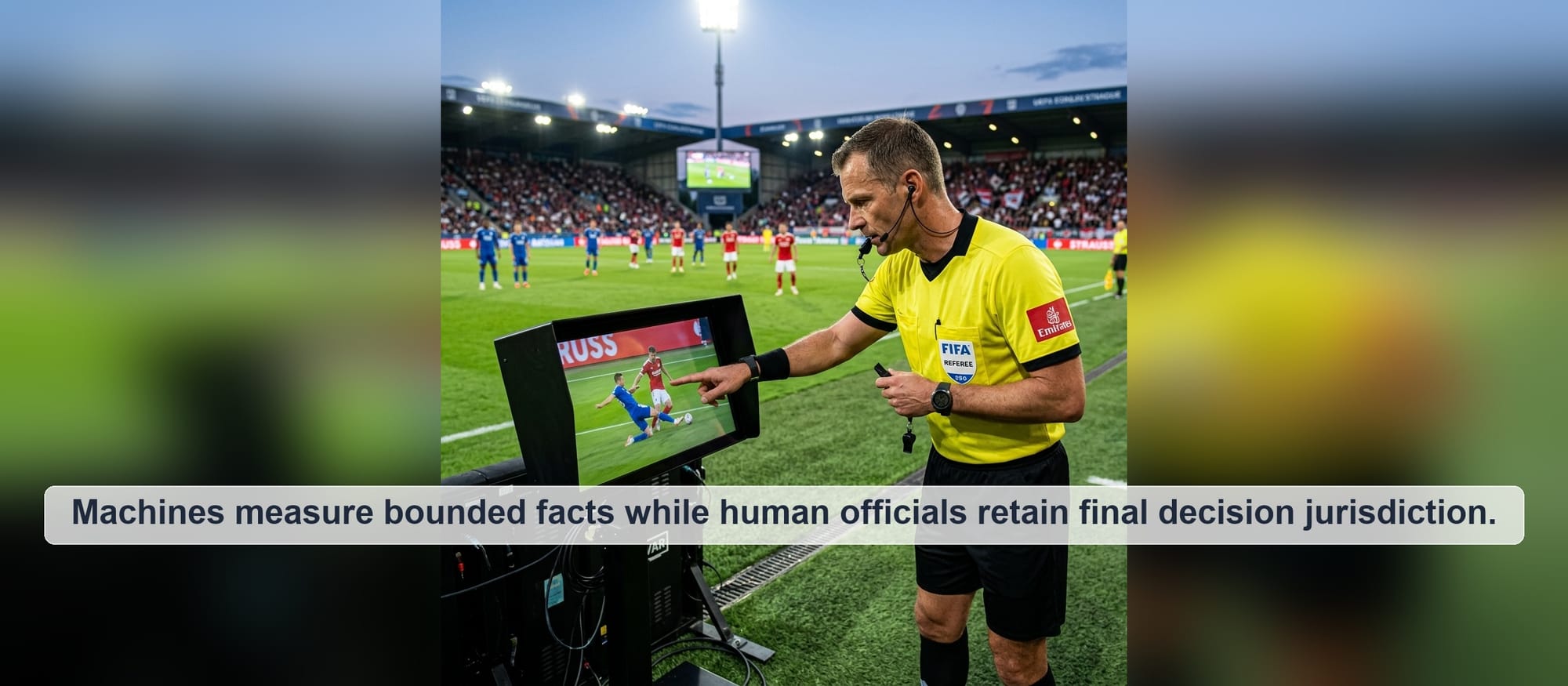
Machines should measure what they are good at measuring. Humans should own the call.
The biggest misunderstanding regarding AI in football matches the same misunderstanding I hear in many Enterprise AI discussions: people assume the end state is replacement.
In my opinion, that is a flawed assumption.
The stronger model is not replacement; rather, it is jurisdiction. Machines collect and measure evidence. Humans interpret the situation, apply the rules, and carry responsibility for the decision.
The World Cup 2026 model appears to follow that logic. It uses a combination of technologies:
- A dozen cameras dedicated to semi-automated offside technology (SAOT), tracking player movement at 50 frames per second.
- Sixteen optical tracking cameras in each stadium, generating over 150 million data points per match for broader analysis and review.
- A connected ball with a motion sensor, giving the system a sharper view of the kick point.
This setup is very good at bounded facts.
Was the ball over the line? Who touched it last? Was a player’s shoulder or knee ahead of the last defender when the ball was played?
Those are geometry and timing issues. Give them to calibrated systems. Let the machine do the measuring.
However, the harder calls remain human calls. Did the offside player interfere with play? Was the contact in the penalty box enough for a foul? Did the handball meet the standard under the rules?
That is where judgment lives.
People like to say “human in the loop.” I have grown tired of that phrase. It often means a human clicks approve after the system has already shaped the answer. That is not authority. That is theater.
The better phrase is “human jurisdiction.” The machine presents evidence. The official owns the decision.
That is the design pattern I would want in any serious AI system that affects financial resources, safety, employment, credit, healthcare, or legal outcomes.
The Loading Spinner Issue
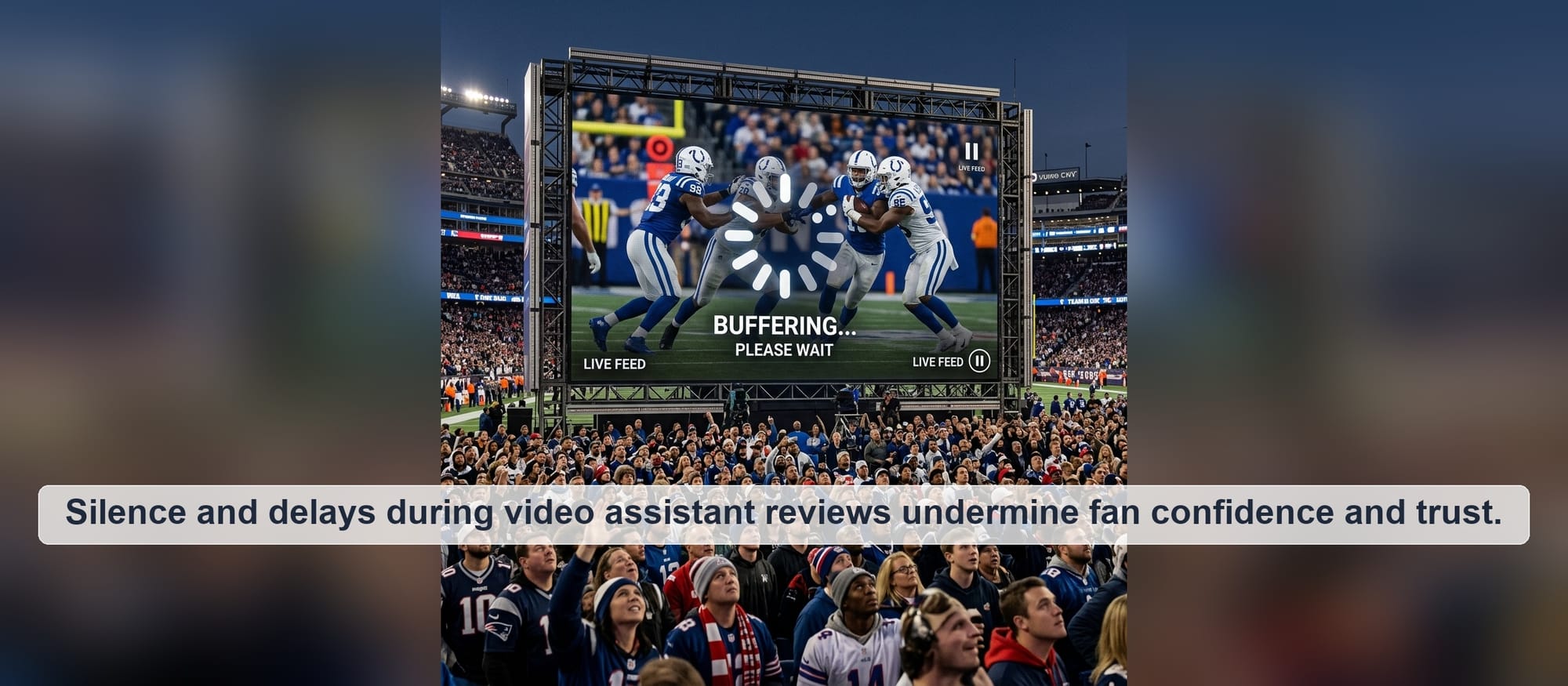
Fairness loses value when nobody understands what just happened.
Technology can make football fairer. However, it can also drain the emotional life out of the moment.
Any fan knows the feeling. A goal goes in. The stadium erupts. Then everyone freezes. The players stop. The crowd looks at the screen. The referee touches the earpiece. Somewhere, unseen people are drawing lines on a digital image.
A goal celebration with a loading spinner is not a great product experience.
Fans do not hate technology by default. Most people accept goal-line technology due to the fact that it is fast and clear. Ball crossed the line. Goal. No goal. Done.
What fans hate is silence, delay, and mystery. They hate feeling that the real match is happening inside a locked room.
Semi-automated offside has helped here. FIFA has said it can reduce the average positional offside review from around 70 seconds to about 25 seconds, according to this BBC Sport report. That is a meaningful improvement. Flow matters in sport, just as it matters in digital products.
However, subjective reviews are still painful. Fouls, handballs, interference, intent. These do not fit neatly into a sensor packet.
Being offside by a shoelace is football’s version of a precision bug. The system may be technically correct, but if the explanation arrives late and badly, trust still takes a hit.
That is a lesson many AI teams miss. Accuracy is not enough. The user experience of the decision matters too.
If people cannot see why the system acted, they will invent a reason. Usually not a generous one.
The Most Honest Word in AI Is Judgment
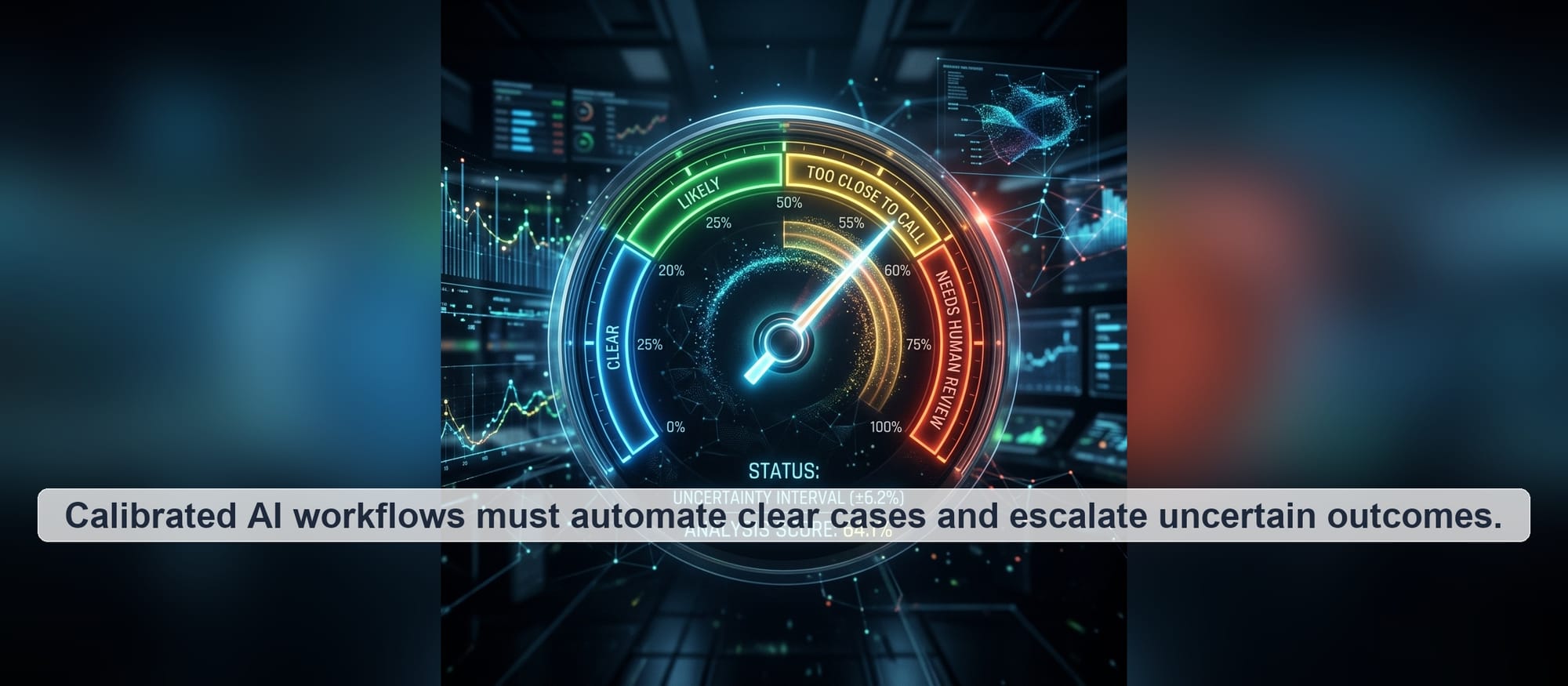
A mature AI system knows when not to pretend.
One of the most sensible aspects of the new offside system is not the instant alert. Rather, it is the restraint around marginal cases.
The system is designed to alert assistant referees when a player is clearly more than 10cm offside. For tighter calls, the human-led VAR process still has to assess the situation. The machine does not need to act brave when the margin is thin.
In my opinion, that represents good engineering.
From my discussions with other tech leaders, I routinely hear about systems that produce confident nonsense. A model gives an answer with a polished tone, a clean format, and the emotional certainty of a person who has never been wrong in their life. Then you check the facts and realize it made things up.
Confidence without calibration is dangerous.
The World Cup approach offers a better pattern: automate the clear cases, escalate the uncertain ones, and make the threshold part of the workflow rather than a hidden parameter buried in documentation.
I wish more Enterprise AI systems worked this way.
In business, uncertainty is often treated like an embarrassment. Product teams hide it. Executives smooth it over. Dashboards round it away. Then the system makes a bad recommendation and everyone acts surprised.
A serious AI workflow should have a visible abstention state. It should be able to say:
- This is clear.
- This is likely.
- This is too close to call.
- This needs human review.
- This evidence is incomplete.
That is not weakness. That is discipline.
The Cybersecurity Premier League
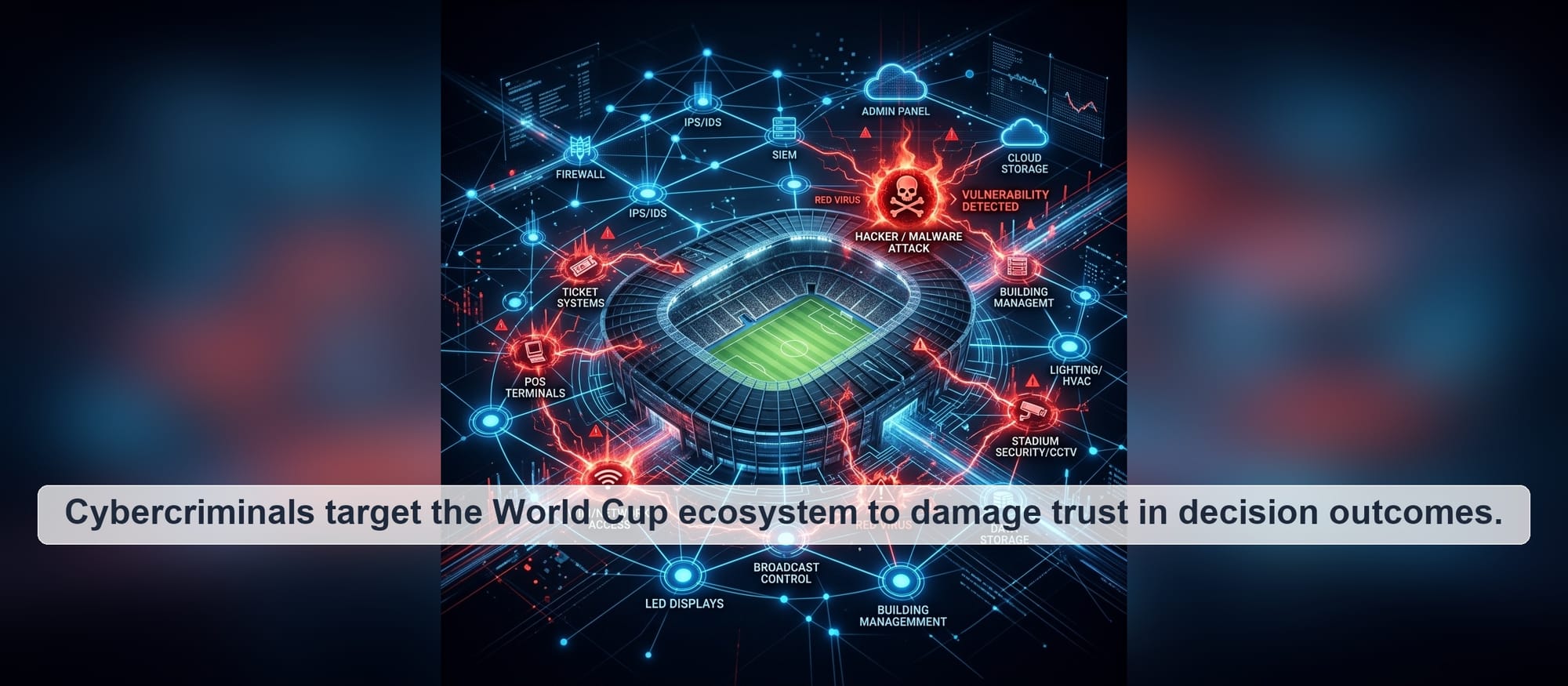
Attackers do not need to change the decision if they can damage belief in the decision.
Now we get to the part that should make every security leader sit up.
When one decision can affect a match, a nation, a sponsor, and a projected global betting handle that could exceed $55 billion to $60 billion, security is not a back-office concern. It is part of the sport.
And no, this is not only about a Hollywood-style “hack the ball” plot. That is the fun headline. The real attack surface is broader and more boring, which usually means it is more dangerous.
Think about the trust rings:
- The decision core: the ball, cameras, VAR systems, referee communications, timing feeds, and operator workstations.
- The decision presentation: broadcast graphics, stadium screens, official feeds, and data APIs used by media and partners.
- The event ecosystem: ticketing platforms, sponsor sites, fan apps, travel scams, credential theft, fake domains, and social media abuse.
An attacker may not need to alter a referee’s call. They may only need to create enough confusion that millions of people doubt the call.
That is cheaper. That is easier. That is often good enough.
Research from Fortinet and Palo Alto Networks points to the scale of the challenge. Between January and May 2026, over 13,000 new World Cup-themed domains were registered, with roughly 8.8% flagged as malicious or suspicious. The same reporting notes that over 270,000 fan and user credentials related to FIFA sites have already been found in stealer logs, alongside more than 260 FIFA employee credentials.
That is not a small nuisance. That is the fog around the event.
And yes, it is funny that the official match ball now has a charging routine. Somewhere, a kit manager has quietly become part of the cybersecurity program.
Funny. Also true.
What Tech Leaders Should Take From This

High-stakes AI needs evidence, boundaries, rehearsal, and explanations people can actually use.
FIFA’s challenge is a useful mirror for any organization deploying AI in serious workflows. Banks, insurers, hospitals, retailers, logistics networks, manufacturers, and governments operate in different fields, yet they face the same trust issue.
Here are the principles I would look for:
- Sign the evidence. Sensor data, camera frames, timestamps, model outputs, and human overrides should be authenticated and logged in a tamper-evident way. If the decision matters, the evidence trail matters.
- Separate the trust zones. The core decision network should not be casually connected to public, commercial, broadcast, sponsor, or analytics systems. Convenience is how risk sneaks in wearing a nice jacket.
- Red-team the full decision pipeline. Do not stop at vulnerability scans. Test spoofed inputs, delayed feeds, bad timestamps, compromised operator accounts, insider misuse, and degraded network conditions.
- Explain by audience. Fans need a simple answer. Teams need the evidence. Auditors need logs. Engineers need telemetry. Executives need risk and accountability. One explanation will not serve all of them.
- Design for uncertainty. Build escalation paths before launch. If your AI system only works when every input is clean and every confidence score is high, you do not have an operating model; rather, you have a “demo.”
- Protect the presentation layer. People often trust what they see first. If the broadcast graphic, screen output, or public feed is wrong, the damage may be done before the official correction arrives.
This is not just a sports lesson. It is an AI governance lesson with better camera angles.
Precision Needs Certification
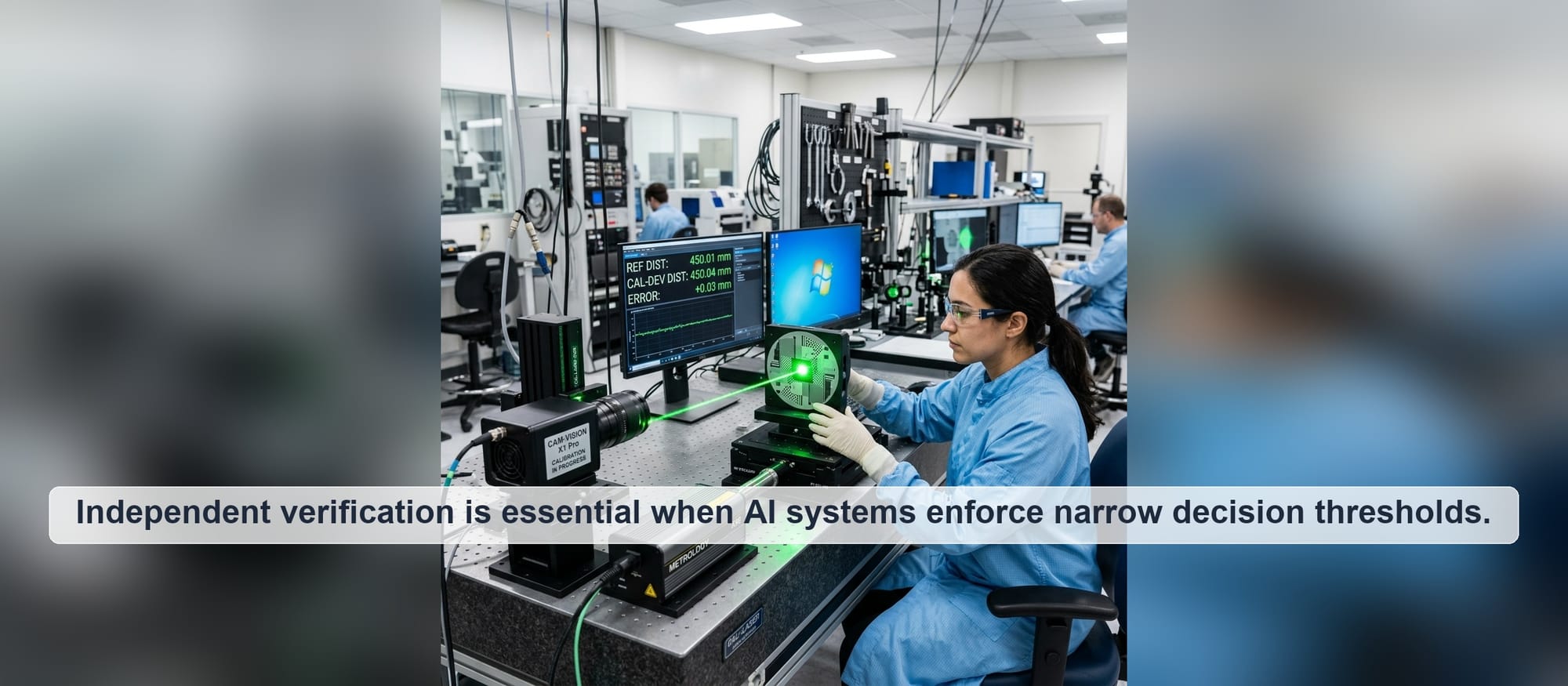
If a system enforces centimeters, someone independent must certify the centimeters.
Here is the uncomfortable engineering question.
If FIFA’s system can send an automated alert for offsides greater than 10cm, how do we know the real-world uncertainty is comfortably below that threshold?
A 2025 preprint analyzing a similar system in La Liga claimed a potential aggregate measurement uncertainty of up to 34cm. That does not prove FIFA’s system has the same issue. Different league. Different setup. Different calibration. Different operating model.
Still, the question is fair.
Who independently certifies the measurement error? How often? Under what conditions? With what equipment? In what stadium lighting? With what camera placement? With what ball behavior? With what network latency?
This is not nitpicking; rather, it is the core of trust.
Any AI system that enforces a narrow threshold needs independent validation. Not vendor confidence. Not marketing language. Not “the model performed well in testing.” Actual certification that the system’s error margin is smaller than the rule it is enforcing.
If the machine is going to judge centimeters, the governance must also operate at centimeter discipline.
Conclusion: Trust Is the Real Match
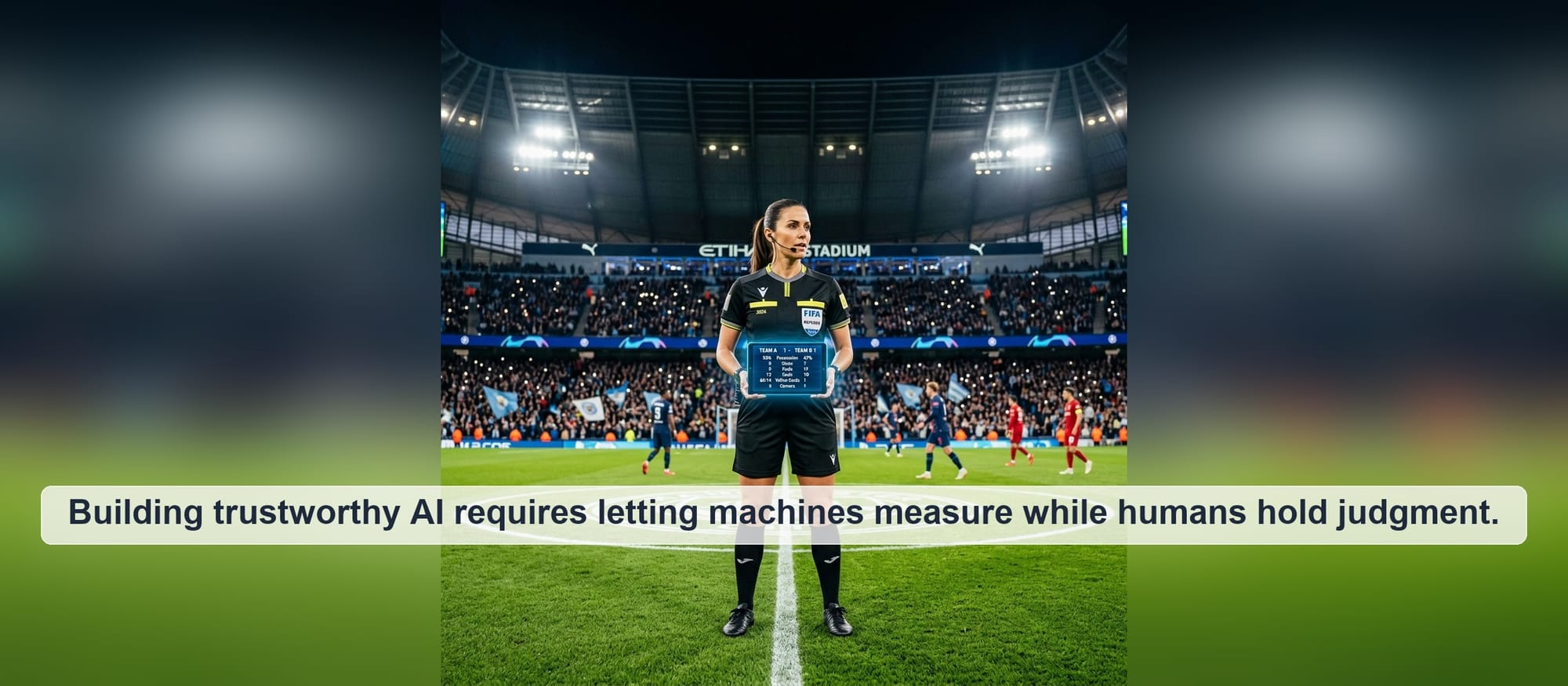
The future is not AI replacing judgment. It is judgment strengthened by evidence people can trust.
World Cup 2026 will not prove that AI can replace referees. I do not believe that is the right test.
The better test is whether a global sport can govern machine evidence in real time, under public pressure, with money, reputation, emotion, and national pride all attached to the outcome.
That is a harder test.
Every organization building real-time AI decision systems will face the same tradeoff: speed, accuracy, and trust. Push too hard on speed and people suspect shortcuts. Push too hard on precision without explanation and people see a “black box.” Leave everything to manual judgment and people ask why the technology exists at all.
The answer sits in the middle.
Let machines measure. Let humans judge. Secure the chain. Explain the call. Admit uncertainty when the evidence is thin.
That may not satisfy every fan after a disallowed goal in the 89th minute.
However, it is a better model than pretending the machine is magic.
Citations and Further Reading
Good engineering arguments need sources, not just strong opinions.
- Etzioni on AI: What the World Cup tells us about the best roles for humans and machines
- Connected ball technology - Inside FIFA
- World Cup 2026: Fifa adds new offside technology to help VAR - BBC
- How AI helps World Cup referees make the call - University of Rochester
- Semi-automated offside is coming for the World Cup. Here's how one referee uses it - The Guardian
- Discussing The World's Biggest Game's Attack Surface - Palo Alto Networks Unit 42
- Artificial Intelligence Referees: Offsides and Out of Bounds - Vanderbilt Law School
- The 2026 FIFA World Cup Ball Runs on a Battery. Here's How It Works - Yahoo Sports
- IBIA | Safeguarding Sports Betting
- Cybercriminals Are Targeting the FIFA World Cup 2026 | Fortinet
- Fortinet finds 13,000 FIFA 2026 scam domains - Backend News
- Semi-automated offside technology to debut at FIFA World Cup 2026 - The Chosun Daily
- Potential Measurement Uncertainty in Semi-Automated Offside Technology: A Case Study of La Liga (2024-25 Season) - preprints.org
- Prediction Markets Could Help Push 2026 World Cup Betting Past $60 Billion - Action Network
- World Cup 2026 Ball Price and Technology: All Details - PhoneArena
- Wired Middle East - World Cup 2026: The Cameras, Sensors, and Digital Twins Behind Every Call
- FIFA's Instagram Post on Connected Ball Technology



Comments ()